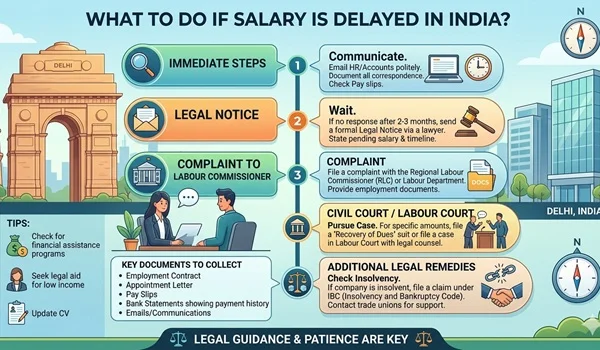
If your salary is delayed in India, first contact your employer or HR department and request payment in writing. If the issue is not resolved, you can file a complaint with the Labour Department, Labour Commissioner, or the appropriate authority under employment laws. Keep records of your employment, salary slips, bank statements, and communications. In many cases, salary disputes can be resolved through formal complaints before legal action becomes necessary.
Is Delayed Salary Legal in India?
Employers are generally expected to pay employees on the agreed salary date mentioned in the employment contract or company policy.
A minor delay due to banking issues may occur occasionally. However, repeated or unreasonable salary delays can lead to legal disputes and complaints before labour authorities.
Employees have the right to receive wages for work performed according to the terms of employment.
Common Reasons for Salary Delays
Some common reasons include:
- Cash flow problems in the company
- Administrative errors
- Payroll processing issues
- Banking delays
- Financial distress of the employer
- Internal disputes within the company
- Business closure or insolvency
Regardless of the reason, employers should communicate clearly with employees regarding payment delays.
Step-by-Step: What to Do If Your Salary Is Delayed
Step 1: Verify the Payment Date
Check:
- Employment contract
- Offer letter
- Company HR policy
- Previous salary payment pattern
Confirm that the salary is actually overdue.
Step 2: Contact HR or Payroll Department
Before taking legal action:
- Send an email to HR
- Contact payroll department
- Request clarification on the delay
Keep all communication in writing.
Example
“Dear HR Team, my salary for the month of ______ has not been credited as of ______. Kindly provide an update regarding the payment timeline.”
Step 3: Send a Formal Written Reminder
If no response is received within a few days:
- Send a follow-up email
- Mention the pending salary amount
- Request payment within a reasonable period
Professional communication often resolves many cases.
Step 4: Collect Supporting Documents
Keep copies of:
- Offer letter
- Employment contract
- Salary slips
- Attendance records
- Bank statements
- Emails and messages
- Employee ID card
These documents may be required if a complaint becomes necessary.
Step 5: Submit an Internal Grievance
Many organizations have:
- Employee grievance cells
- HR escalation systems
- Internal complaint mechanisms
Follow the official process before approaching authorities.
Step 6: File a Complaint with Labour Authorities
If the employer still does not pay:
You may approach:
- Labour Commissioner
- Labour Department
- Labour Officer
- Conciliation Officer
The authority may call both parties and attempt a settlement.
Step 7: Consider Legal Action
If the dispute remains unresolved:
- Labour Court proceedings may be available in certain cases
- Civil recovery proceedings may be considered
- Legal notices may be issued through an advocate
Professional legal advice is recommended for significant salary disputes.
Legal Procedure for Salary Recovery
Stage 1: Complaint Submission
Employee submits:
- Complaint application
- Supporting documents
- Identity proof
Stage 2: Notice to Employer
The labour authority may:
- Contact employer
- Seek explanation
- Request payment details
Stage 3: Conciliation
A settlement meeting may be arranged.
Many disputes are resolved at this stage.
Stage 4: Further Proceedings
If settlement fails:
- Matter may proceed before appropriate legal forums
- Additional evidence may be required
Authorities You Can Approach
Labour Department
Handles employee complaints regarding unpaid wages and labour disputes.
Labour Commissioner
Senior authority responsible for labour administration.
Labour Officer
Often the first point of contact for local disputes.
Labour Court
May handle unresolved employment disputes depending on the nature of the case.
Industrial Tribunal
May become involved in larger employment disputes where applicable.
Documents Required for a Salary Complaint
Employment Documents
- Offer Letter
- Appointment Letter
- Employment Contract
Salary Records
- Salary Slips
- Bank Statements
- Payroll Records
Communication Records
- Emails
- Messages
- Complaint Letters
Identity Documents
- Aadhaar Card
- PAN Card
- Employee ID
Fees and Costs
Internal Complaint
| Process | Fee |
| HR Complaint | Usually Free |
| Internal Grievance | Usually Free |
Labour Authority Complaint
| Process | Fee |
| Labour Department Complaint | Usually Free or Nominal |
| Conciliation Proceedings | Usually Free |
Legal Proceedings
| Process | Approximate Cost |
| Advocate Consultation | Varies |
| Legal Notice | Varies |
| Court Proceedings | Depends on case |
Costs differ based on location and complexity.
Timelines for Resolution
| Stage | Approximate Time |
| HR Response | 3–15 Days |
| Internal Escalation | 1–4 Weeks |
| Labour Complaint Review | 2–8 Weeks |
| Conciliation Process | 1–3 Months |
| Court Proceedings | Several Months or More |
Actual timelines vary depending on workload and facts of the case.
Can an Employer Withhold Salary?
An employer generally cannot arbitrarily withhold earned salary without lawful reasons.
Disputes may arise regarding:
- Unauthorized absence
- Notice period issues
- Recovery of advances
- Contractual deductions
However, employers should clearly explain any deductions or withholding.
What If the Company Closes Down?
If a company shuts down:
- Collect employment records immediately.
- Obtain pending salary details.
- Contact labour authorities.
- Preserve all evidence of employment.
- Seek professional legal advice if substantial amounts are involved.
Acting early can improve recovery prospects.
Tips to Avoid Problems During Salary Recovery
Keep Written Records
Avoid relying only on verbal discussions.
Save Every Salary Slip
Salary slips are valuable evidence.
Use Official Email
Always communicate through company email when possible.
Remain Professional
Avoid threats or abusive messages.
Professional communication strengthens your case.
Maintain Attendance Records
Keep copies of:
- Attendance reports
- Work logs
- Project assignments
These can help prove employment and work performed.
Common Mistakes to Avoid
❌ Waiting several months before raising the issue
❌ Relying only on verbal conversations
❌ Deleting emails and messages
❌ Resigning without preserving evidence
❌ Posting confidential company information online
❌ Signing documents without reading them
❌ Ignoring official notices from authorities
Salary Delay Complaint Checklist
Before filing a complaint, ensure you have:
Employment Proof
☐ Offer Letter
☐ Appointment Letter
☐ Employee ID
☐ Employment Contract
Salary Proof
☐ Salary Slips
☐ Bank Statements
☐ Payroll Records
Communication Records
☐ HR Emails
☐ Follow-Up Emails
☐ Salary Reminder Messages
Personal Documents
☑ Aadhaar Card
☑ PAN Card
☑ Contact Details
Complaint Preparation
☑ Exact Pending Salary Amount
☑ Salary Due Date
☑ Copies of All Supporting Documents
Frequently Asked Questions (FAQs)
Q: How many days can an employer delay salary?
A: The answer depends on employment terms and applicable laws. Repeated or unreasonable delays may justify a complaint before labour authorities.
Q: Can I file a complaint against my employer for delayed salary?
A: Yes. Employees can approach labour authorities if salary remains unpaid despite requests and reminders.
Q: Will I lose my job for filing a salary complaint?
A: Employers should not take unfair action merely because an employee seeks lawful remedies. However, each situation depends on its specific facts.
Q: Is an email sufficient proof of salary delay?
A: Emails can be important supporting evidence, especially when combined with salary slips and bank statements.
Q: Can I claim interest on delayed salary?
A: Whether interest can be claimed depends on the facts, contractual terms, and applicable legal proceedings.
Q: What if the employer stops responding?
A: Maintain records of all communications and consider approaching labour authorities.
Q: Can contractual employees complain about delayed salary?
A: Yes. Contractual employees may also have legal remedies depending on their employment arrangement and applicable laws.
Q: Can I resign if my salary is repeatedly delayed?
A: You may choose to resign according to your employment terms, but preserve all records and evidence before leaving.
Conclusion
A delayed salary can create significant financial stress, but employees in India have several options to address the issue. Start by contacting HR or payroll, maintain proper documentation, and use the company’s grievance process. If the employer fails to resolve the matter, labour authorities can assist in recovering unpaid wages and facilitating settlement. Acting promptly, keeping written records, and following the proper legal process can greatly improve the chances of a successful resolution.
Disclaimer: This article is for general informational purposes only and should not be considered legal advice. Laws and procedures may vary depending on the employee’s role, salary level, state, and specific circumstances. For case-specific guidance, consult a qualified legal professional.