Lenskart has transformed the eyewear industry in India with an innovative, omnichannel business model that blends online convenience, offline trust, and highly efficient supply-chain economics. Founded in 2010 by Peyush Bansal, the brand disrupted a traditionally unorganized market where eyewear was expensive, limited in variety, and difficult to purchase without expert guidance. Today, Lenskart is one of India’s most successful D2C–plus–retail brands, with over 2,000 stores domestically and internationally, millions of app users, and strong investor backing.
Its business model stands out because it uses technology, vertical integration, and customer-centric services like home eye tests and 3D try-on. By controlling the entire eyewear journey—from manufacturing to doorstep delivery—Lenskart delivers quality at scale while maximizing profitability. This article breaks down how Lenskart creates value, solves customer pain points, and earns revenue through an intelligent business model.
The Problem & Customer Pain Points
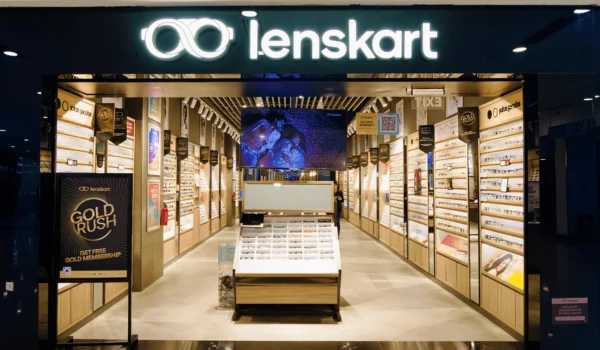
Before Lenskart entered the market, eyewear purchasing in India was inconvenient and inefficient. A few common problems dominated the customer experience:
High Cost of Eyewear
Eyewear, especially prescription glasses, often cost ₹3,000–₹7,000 because local opticians relied on wholesalers, importers, small-scale manufacturers, and multiple middlemen. Each layer increased pricing.
Limited Design Options
Traditional stores offered limited styles—usually fewer than 100 frames—leaving customers with minimal choice.
Poor Accessibility & Lack of Reach
In semi-urban or rural areas, quality optical stores were almost non-existent. People had to travel long distances for eye tests or new spectacles.
Inconsistent Quality
Lens quality, fitting accuracy, and after-sales support varied widely. Customers often had no clarity on warranty or return policies.
Fragmented Customer Journey
Eye testing, frame selection, lens fitting, and delivery were rarely integrated. Customers had to visit multiple places, often creating confusion and delays.
Lack of Technology
There was no digital support—no virtual try-on, no online verification, and limited transparency in product details.
Lenskart’s model directly targets these pain points through affordability, accessibility, technology, and an integrated retail ecosystem.
The Solution & Customer Journey
Lenskart redesigned the eyewear journey to solve customer problems holistically. Here’s how the customer journey transitions from problem → solution → satisfaction:
Step 1: Problem Identification
A customer needs spectacles or wants to upgrade to stylish frames. They may lack time, access to a good optician, or clarity on prices.
Step 2: Easy Accessibility Through Omnichannel Presence
Customers can choose between:
- Online purchase via website/app
- Visiting a nearby Lenskart store
- Home eye checkup, where certified technicians perform tests at home
This flexibility ensures convenience for all segments.
Step 3: Accurate Eye Testing
Eye tests are conducted using technology-powered tools—either in-store or via home visits. This builds trust and reduces the risk of incorrect prescriptions.
Step 4: Virtual & In-Person Frame Selection
Customers can try thousands of frames:
- 3D virtual try-on helps online buyers visualize fit and style.
- Offline stores display 300–1,000+ frames for hands-on experience.
- Staff provides fashion, fit, and functional recommendations.
Step 5: Fast Manufacturing & Supply Chain
Lenskart manufactures many of its own frames and lenses in automated facilities. This:
- Reduces cost
- Ensures consistency
- Enables 24–48 hour delivery for many orders
Step 6: Delivery, After-Sales & Warranty
Customers receive their glasses quickly with:
- 14-day return policy
- One-year warranty for many products
- LensGuard protection for accidental damage
Step 7: Customer Satisfaction
The seamless journey—test → choose → deliver—provides high satisfaction. The process is transparent, tech-enabled, and affordable. This builds long-term loyalty and repeat purchases.
Thus, Lenskart delivers value by merging technology, retail convenience, and manufacturing efficiency into a smooth customer journey.
How Lenskart Makes Money
Lenskart follows a D2C + Retail + Subscription business model supported by vertical integration. Here’s how the company generates revenue:
✔ Primary Revenue Streams
| Revenue Stream | Description |
| Eyewear Sales (Core Revenue) | Frames, lenses, sunglasses, computer glasses, and contact lenses sold online/offline. |
| Premium Collections | Higher-margin categories such as AirFlex, Air Titanium, Blu Computer Glasses. |
| Lenskart Gold Membership | Subscription model offering discounts and benefits; generates recurring revenue. |
| Home Eye Test Services | Revenue from at-home testing appointments. |
| International Stores | Earnings from overseas markets (UAE, Singapore, SEA). |
| Accessories & Add-ons | Lens coatings, cases, cleaning kits, protection plans. |
| Brand Collaborations | Limited-edition collections and co-branded designs. |
✔ Pricing Strategy
- Frames start as low as ₹999–₹1499, appealing to mass consumers.
- Premium products go up to ₹5,000–₹15,000, improving margins.
- Vertical manufacturing allows Lenskart to keep prices competitive.
✔ Unit Economics
- CAC (Customer Acquisition Cost)
Lower due to:
- Organic word-of-mouth
- Omnichannel presence
- Returning customers
- Low-cost digital marketing
- LTV (Lifetime Value)
High because customers:
- Replace glasses every 1–3 years
- Buy sunglasses/computer glasses
- Often purchase for family
- Renew Gold membership
- Gross Margins
Lenskart enjoys 50–60% margins due to:
- In-house manufacturing
- Bulk production
- High-margin premium collections
- Operating Margin
Improves with scale, data-driven inventory management, and store expansion.
Why Lenskart’s Money-Making Model Works
- Vertical Integration reduces dependency on middlemen.
- Omnichannel Retail captures both online and offline markets.
- Subscription Model ensures steady recurring revenue.
- Technology enhances experience and reduces returns.
- GLOBAL Expansion opens new revenue pools.
Together, these factors create a sustainable, scalable profit engine.
Example
Case Study: Neha’s Eyewear Journey with Lenskart
Neha is a working professional who recently experienced eye strain and needed new spectacles. Earlier, she disliked visiting crowded optical shops with limited options.
Here’s how Lenskart solved her problem:
- Home Eye Test:
She booked a home eye test via the Lenskart app. A certified technician arrived with equipment and conducted a full test. - Frame Selection:
She used the 3D virtual try-on tool to shortlist 10 frames. She visited a nearby Lenskart store to see them physically and finalize her choice. - Transparent Pricing:
She chose a frame worth ₹1,499 and upgraded to Blu lens with anti-glare coating. Clear pricing and EMI options made the decision easier. - Fast Delivery:
Her glasses were delivered within 48 hours. - After-Sales:
She received a 1-year warranty and a 14-day no-questions-asked return policy.
Revenue Impact (For Lenskart):
- Eyewear sale (frame + lenses)
- Blu lens upgrade
- Gold membership purchase for discounts
- Increased LTV due to future purchases
This case showcases how Lenskart maximizes value for both the customer and its bottom line.
Key Insights
Lenskart’s business model is strong because it blends technology, customer-centric services, vertical integration, and smart pricing. Its omnichannel approach solves major pain points in the eyewear buying experience. By manufacturing its own products, offering affordable pricing, and using tech-enabled tools like virtual try-on and AI-driven inventory, it ensures high-quality service and strong margins. The subscription model, repeat demand, and global expansion make revenue sustainable. For entrepreneurs, Lenskart is a perfect example of how innovation + supply-chain control can disrupt a traditional market and build a scalable, profitable business.