In Maharashtra, many housing societies face a common property-related problem: the builder sells flats to buyers, the society is formed, and residents start managing the building, but the land and building are not legally transferred to the society.
This can create difficulties when the society wants to redevelop the building, carry out major repairs, obtain certain permissions or establish its ownership rights over the property.
To address this problem, Maharashtra law provides a remedy known as Deemed Conveyance.
Deemed conveyance is a legal process through which a cooperative housing society can obtain a conveyance certificate from the competent authority when the developer or landowner fails to execute the required conveyance deed voluntarily.
It is particularly important for housing societies because it helps transfer the right, title and interest of the promoter in the land and building to the society, subject to the applicable law and the facts of the case.
This article explains the meaning of deemed conveyance, its benefits, eligibility, required documents, application procedure, costs and common challenges faced by housing societies in Maharashtra.
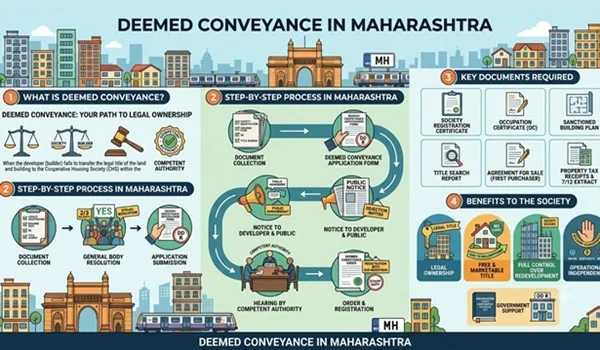
What Is Deemed Conveyance?
Deemed Conveyance is a legal mechanism available under the Maharashtra Ownership Flats (Regulation of the Promotion of Construction, Sale, Management and Transfer) Act, 1963, commonly known as the MOFA Act.
Under Section 11 of MOFA, a promoter is required to take steps to convey the promoter’s right, title and interest in the land and building to the organisation of flat purchasers, such as a cooperative housing society, within the prescribed period and in accordance with the agreement and applicable law.
However, some developers fail to execute the conveyance deed even after selling flats and forming the housing society.
In such cases, the society can apply to the competent authority for a certificate of deemed conveyance.
After examining the application and relevant documents, the authority may issue the certificate if the legal requirements are satisfied.
Deemed conveyance allows a housing society to pursue the transfer of the promoter’s rights in the property even when the promoter does not cooperate.
It is important to understand that deemed conveyance does not automatically give the society ownership of more land or rights than the promoter was legally required and entitled to convey.
What Is the Difference Between Conveyance Deed and Deemed Conveyance?
A regular conveyance deed and deemed conveyance serve a similar purpose, but the process through which they are obtained is different.
| Basis | Regular Conveyance | Deemed Conveyance |
| Meaning | Voluntary transfer of property rights through a conveyance deed | Statutory process for obtaining conveyance when the promoter fails to execute it |
| Initiated by | Promoter and housing society or other eligible organisation | Housing society or eligible organisation |
| Developer’s cooperation | Generally required | Not necessary if the statutory process is completed |
| Legal basis | Applicable property and registration laws, including MOFA where relevant | Section 11 of MOFA |
| Authority involvement | Registration of the executed deed | Competent authority examines the application and issues a deemed conveyance certificate |
| Main purpose | Transfer of the promoter’s rights in the property | Enable transfer despite the promoter’s failure or refusal |
In a regular conveyance, the developer executes the deed voluntarily and the parties complete the registration process.
In deemed conveyance, the society approaches the competent authority because the promoter has failed to fulfil the conveyance obligation.
Why Is Deemed Conveyance Important for Housing Societies?
Obtaining deemed conveyance is important because a housing society may manage the building and collect maintenance charges without holding the legal title to the underlying land and building.
The society’s legal position can remain incomplete until the conveyance is executed and registered.
Here are the major benefits.
Establishes the Society’s Ownership Rights
After the deemed conveyance deed is properly registered, the society obtains the promoter’s right, title and interest in the land and building covered by the deed.
This helps the society establish its legal ownership rights and maintain the relevant property records.
Helps in Building Redevelopment
Redevelopment is one of the major reasons why housing societies apply for deemed conveyance.
A society may face difficulties while planning redevelopment if the land title continues to remain in the name of the original landowner or developer.
Conveyance helps establish the society’s title and provides an important legal foundation for redevelopment, subject to planning permissions, development regulations and other applicable requirements.
Reduces Dependence on the Builder
Some developers do not execute conveyance even after selling all the flats and forming the society.
Deemed conveyance provides a statutory remedy when the developer fails to fulfil this responsibility.
The society can pursue the process without depending entirely on the builder’s cooperation.
Helps Obtain a Clearer and More Marketable Title
A registered conveyance deed and corresponding land-record updates help establish the society’s rights over the property.
This can reduce uncertainty about ownership and make future property-related transactions easier.
Helps with Repairs and Property Management
A society with proper conveyance documents is in a stronger position to deal with property-related matters involving land, common areas and redevelopment.
However, conveyance does not automatically replace other approvals required for major repairs, construction or redevelopment.
Who Is Eligible to Apply for Deemed Conveyance in Maharashtra?
Under Section 11 of MOFA, an eligible organisation of flat purchasers can apply for unilateral deemed conveyance if the promoter fails to execute the conveyance as required by law.
Eligible organisations may include:
- Registered cooperative housing societies
- Companies formed by flat purchasers, where applicable
- Associations of apartment owners covered by the relevant provisions
For a typical residential housing society, the application is generally made in the society’s name through its authorised representatives.
The society should generally satisfy the following conditions:
- It must have been legally formed and registered, where registration is applicable.
- The members should have purchased flats under agreements with the promoter.
- The promoter should have failed to execute the required conveyance.
- The society should have relevant property and flat-purchase documents.
- The society should pass an appropriate resolution authorising the application.
A society does not need the builder’s consent to initiate the statutory deemed conveyance process. However, the promoter and other concerned parties must receive the opportunity to respond during the legal procedure.
What Is the Role of Section 11 of MOFA?
Section 11 of the Maharashtra Ownership Flats (Regulation of the Promotion of Construction, Sale, Management and Transfer) Act, 1963, deals with the promoter’s responsibility to convey title and execute the required documents.
The important provisions are:
Section 11(1): Promoter’s Responsibility
The promoter must take the necessary steps to complete the title and convey the promoter’s right, title and interest in the land and building to the organisation of flat purchasers.
The promoter must also execute the relevant documents according to the agreements and applicable rules.
Section 11(3): Application for Deemed Conveyance
If the promoter fails to execute the conveyance within the prescribed period, the eligible society or other organisation may apply to the competent authority.
The application must include true copies of the registered agreements for sale and other relevant documents.
Section 11(4): Certificate by Competent Authority
The competent authority examines the application, verifies the documents and gives the promoter a reasonable opportunity to be heard.
If satisfied that it is an appropriate case, the authority issues a certificate confirming that unilateral deemed conveyance can be pursued.
Section 11(5): Registration of Deemed Conveyance
The society submits the certificate and unilateral conveyance instrument to the appropriate registering officer.
The Sub-Registrar follows the prescribed procedure, including giving the promoter an opportunity to show cause, before deciding whether to register the instrument as deemed conveyance.
Receiving the deemed conveyance certificate is not the final step. The unilateral conveyance deed must also be properly stamped and registered.
How Can a Housing Society Obtain Deemed Conveyance in Maharashtra?
The process generally involves preparing the society’s documents, submitting an application, attending the hearing, obtaining the authority’s certificate, completing stamp duty and registering the conveyance deed.
The following are the major steps.
Step 1: Pass a Society Resolution
The housing society should first discuss the deemed conveyance proposal in a general body meeting.
Members should consider the need for conveyance and authorise the managing committee or designated representatives to take the necessary steps.
The society should pass a resolution authorising:
- Filing the deemed conveyance application
- Appointing an advocate or authorised representative, if required
- Collecting property-related documents
- Communicating with the developer and landowner
- Preparing and registering the conveyance deed
Keep a certified copy of the resolution for the application.
Step 2: Collect the Required Documents
The society should collect the available property documents and records of flat purchasers.
Important documents may include:
- Society registration certificate
- General body meeting resolution
- List of society members
- Registered flat purchase agreements
- Index II documents
- Land ownership records
- Property card or 7/12 extract
- Approved building plan
- Commencement Certificate, where applicable
- Completion Certificate, where available
- Occupancy Certificate, where available
- Development agreement
- Power of Attorney, if applicable
- Details of the original landowner and developer
- Architect’s certificate or land measurement details, as required
- Copy of the legal notice sent to the promoter
The precise document checklist should be checked on the applicable government application system because requirements can change.
Step 3: Send a Legal Notice to the Builder
Before proceeding, the society should generally send a written notice to the promoter or developer requesting execution of the conveyance deed.
The notice should clearly mention:
- Society details
- Project and property details
- The promoter’s conveyance obligation
- Request to execute the conveyance deed
- Reasonable time to respond
Keep proof of delivery and a copy of the notice.
If the builder does not respond or refuses to execute the deed, the society can use the available records to support its application.
Step 4: Prepare and Submit the Application
The society should prepare the application in the prescribed format, traditionally known as Form VII, under Section 11(3) of MOFA.
The application is made to the competent authority having jurisdiction over the property.
It generally includes:
- Society details
- Project and land details
- Developer and landowner information
- Details of flat purchasers
- Conveyance-related facts
- Copies of relevant agreements and property documents
- Supporting affidavits and declarations, where required
Maharashtra has introduced online systems for deemed conveyance applications. Societies should check the current application process and document requirements on the government service portal.
Step 5: Document Scrutiny by the Competent Authority
After submission, the authority examines the application and supporting documents.
It may ask the society to provide additional information or correct deficiencies.
The society should respond within the time specified and upload or submit the requested documents through the applicable procedure.
Step 6: Attend the Hearing
The competent authority gives the promoter and other relevant parties an opportunity to present their position.
The developer or original landowner may raise objections regarding:
- Land ownership
- Plot boundaries
- Development rights
- Construction area
- Flat agreements
- Available Floor Space Index (FSI)
- Project approvals
- Other property-related issues
The society should submit supporting documents and respond to relevant objections.
If the matter is complicated, legal assistance can be useful.
Step 7: Obtain the Deemed Conveyance Certificate
After examining the documents and hearing the concerned parties, the competent authority decides whether the application qualifies for deemed conveyance.
If satisfied, it issues the certificate under the relevant provisions of Section 11.
The certificate allows the society to proceed with the unilateral execution and registration of the conveyance deed.
Step 8: Get Stamp Duty Adjudicated
The society must prepare the unilateral conveyance instrument and determine the applicable stamp duty.
The duty depends on the property documents, transaction history, land and building details, earlier stamp duty payments and applicable exemptions or concessions.
Where required, the draft deed can be submitted to the Collector of Stamps for adjudication.
Do not assume that every society has to pay the same fixed stamp duty per flat. The applicable amount depends on the facts and relevant stamp duty provisions.
Step 9: Register the Deemed Conveyance Deed
After completing the stamp duty requirements, the society submits the conveyance deed and deemed conveyance certificate to the jurisdictional Sub-Registrar.
The registering officer follows the procedure under Section 11(5) of MOFA.
After the required formalities and hearing process, the deed may be registered as deemed conveyance.
The society should obtain the registered deed and preserve the registration details.
Step 10: Update the Land Records
After registration, the society should apply to the relevant land-record authority for mutation or updating of the property records.
Depending on the location, this may involve:
- Property card
- 7/12 extract
- Other applicable revenue or city survey records
The society should verify that the land records reflect the registered conveyance as required.
Important: The process is not complete merely because the society receives the deemed conveyance certificate. Registration of the conveyance deed and the relevant land-record updates are also important.
Documents Required for Deemed Conveyance
The following table provides a practical checklist. The exact documents may differ according to the project’s legal and land-record situation.
| Document | Purpose |
| Society registration certificate | Establishes the society’s legal registration |
| General body resolution | Authorises the deemed conveyance application |
| List of members | Provides details of flat purchasers |
| Registered flat agreements | Establishes the members’ purchase transactions |
| Index II | Provides registration details of property agreements |
| Property card or 7/12 extract | Shows available land-record information |
| Development agreement | Helps establish the developer’s rights and obligations |
| Power of Attorney | Shows the authority granted to the developer, if applicable |
| Approved building plan | Provides details of sanctioned construction |
| Commencement Certificate | Shows permission to begin construction, where applicable |
| Completion or Occupancy Certificate | Provides completion or occupation-related information, where available |
| Architect’s certificate | Helps establish the building and land details |
| Legal notice to the promoter | Shows that the society requested conveyance |
| Affidavit | Supports the facts stated in the application |
Missing documents do not always mean that the society cannot apply. The society should check the applicable rules and ask the competent authority or a property lawyer how the missing records can be addressed.
What Is the Cost of Deemed Conveyance in Maharashtra?
The cost of deemed conveyance depends on the property, stamp duty assessment, registration requirements and professional assistance.
Common expenses include:
- Application fee
- Stamp duty
- Registration charges
- Certified copies of property documents
- Architect’s or surveyor’s fees
- Legal consultation charges
- Drafting of the conveyance deed
- Land measurement expenses, where required
- Mutation or land-record update charges, where applicable
The application fee and other government charges should be checked through the current government service system.
Stamp duty is particularly important because the amount may depend on the property’s legal and financial history.
In certain cases, concessions or specific stamp duty treatment may be available, subject to the applicable conditions. For example, the treatment may differ where the flat agreements have already been duly stamped and no balance FSI is involved.
There is no safe universal figure for the total cost of deemed conveyance. The society should obtain a proper stamp duty assessment before budgeting for registration.
How Much Time Does Deemed Conveyance Take?
The time required depends on document availability, objections, land ownership issues, hearing schedules and the registration process.
Under Section 11(4) of MOFA, the competent authority is required to decide the application within a reasonable time and, under the statutory text, not later than six months after receiving it, subject to the applicable procedure.
Maharashtra has also introduced online processing to make applications, scrutiny, hearings and tracking more convenient.
A Government Resolution dated 23 October 2026 announced a revised administrative process with a proposed 120-day service timeline and fewer scrutiny stages. However, the revised online system was reported as still under development at the time of writing. Societies should confirm which procedure and timeline are actually operational when filing their applications.
Even where a service timeline applies, complicated or contested cases may require additional practical time for resolving issues and completing registration.
What If the Builder Objects to Deemed Conveyance?
A developer or original landowner may object to the society’s application.
Common objections include:
- Disagreement about the extent of land to be conveyed
- Disputes about ownership
- Claims relating to additional FSI or development rights
- Differences in approved and actual construction
- Missing agreements or property documents
- Disputes regarding the project layout
- Claims relating to other buildings or phases
The competent authority considers the relevant documents and submissions before deciding the application.
The society should not assume that every objection will automatically prevent deemed conveyance.
However, it must provide accurate property information and establish the rights it is seeking to have conveyed.
If the dispute involves complicated title questions, land boundaries or third-party ownership claims, legal proceedings or additional clarification may be necessary.
Can a Housing Society Obtain Deemed Conveyance Without an Occupancy Certificate?
The absence of an Occupancy Certificate does not automatically mean that a society is ineligible for deemed conveyance.
Section 11(3) of MOFA refers to relevant documents, including the Occupancy Certificate, if any.
This means the certificate is not stated as an absolute document requirement in every case under that provision.
However, the absence of an OC may indicate a separate building approval or occupation-related issue.
The society should:
- Check why the OC was not issued.
- Obtain the available construction and approval records.
- Explain the position in its application.
- Check the current document requirements of the competent authority.
- Seek legal advice if the building has unauthorised construction or pending approval issues.
Deemed conveyance does not regularise unauthorised construction or automatically grant an Occupancy Certificate.
What Happens After Deemed Conveyance Is Granted?
After the conveyance deed is registered, the society should preserve the registered document and complete the relevant property-record formalities.
The society should take the following steps:
- Obtain the registered conveyance deed.
- Keep the deemed conveyance certificate and registration receipt.
- Apply for mutation in the relevant land records.
- Verify the updated property card or 7/12 extract, as applicable.
- Preserve the sanctioned plans and other property approvals.
- Maintain a record of land area and property boundaries.
- Keep the documents safely for future redevelopment and legal transactions.
The society should also have its legal adviser review the final deed to confirm that the property description and extent of rights are correctly recorded.
Common Mistakes Housing Societies Should Avoid
Housing societies should be careful while preparing and filing a deemed conveyance application.
Common mistakes include:
- Not passing a proper general body resolution.
- Submitting incomplete or inconsistent flat agreement records.
- Failing to identify the original landowner.
- Ignoring the developer’s legal rights and development agreements.
- Not checking the property card or 7/12 extract.
- Providing incorrect land area or survey details.
- Not sending a proper legal notice to the promoter.
- Ignoring objections raised by the competent authority.
- Assuming that the deemed conveyance certificate itself completes registration.
- Failing to pay the correctly assessed stamp duty.
- Not updating the land records after registration.
A complete and accurate application can help reduce objections and unnecessary delays.
Frequently Asked Questions (FAQs)
Is deemed conveyance mandatory for housing societies in Maharashtra?
The promoter has a legal obligation under Section 11 of MOFA to convey the required rights in the land and building to the eligible organisation of flat purchasers. If the promoter fails to do so, the society can pursue deemed conveyance. Obtaining conveyance is important for establishing the society’s title.
Can a society apply for deemed conveyance without the builder’s signature?
Yes. Deemed conveyance is specifically intended to provide a statutory route when the promoter fails to execute the conveyance deed. The society can apply to the competent authority without relying on the builder’s consent, subject to the prescribed procedure.
Who issues the deemed conveyance certificate in Maharashtra?
The certificate is issued by the competent authority appointed under MOFA. The relevant authority is generally the District Deputy Registrar of Cooperative Societies having jurisdiction over the property. Certain areas, such as CIDCO areas, may have a designated authority.
Is Form VII required for deemed conveyance?
Form VII has traditionally been used for applications under Section 11(3) of MOFA. Societies should check the current online application process and prescribed form requirements before filing.
Can a society apply for deemed conveyance if the builder is missing?
Yes. The society may pursue the statutory process even if the builder is unavailable, subject to identifying and notifying the relevant promoter and other concerned parties as required by law.
Can deemed conveyance be obtained if some flat agreements are missing?
Missing agreements can create difficulties because the authority needs to verify the rights of flat purchasers. The society should collect available registered agreements, Index II records and other supporting documents and obtain advice on how to address missing records.
Does deemed conveyance give ownership of the entire plot?
It transfers the promoter’s right, title and interest in the land and building that the promoter is legally required and entitled to convey. It does not automatically give the society rights over unrelated land or additional property beyond the legally established entitlement.
Can a society redevelop its building after deemed conveyance?
Deemed conveyance can help establish the society’s title and provide an important foundation for redevelopment. However, redevelopment also requires compliance with applicable development regulations, planning permissions, society procedures and other legal requirements.
Does deemed conveyance require stamp duty?
Yes, the conveyance instrument must satisfy applicable stamp duty requirements before registration. The amount depends on the relevant property records, earlier stamp duty payments and applicable legal provisions.
Is deemed conveyance possible for an old housing society?
Yes. An old housing society may apply if it satisfies the legal requirements and the promoter has failed to execute the required conveyance. The society should collect the available historical agreements, land records and building documents.
Conclusion
Deemed conveyance is an important legal remedy for cooperative housing societies in Maharashtra when developers fail to transfer the required property rights through a regular conveyance deed.
Under Section 11 of MOFA, an eligible society can approach the competent authority, submit the required documents, participate in the hearing process and obtain a certificate for unilateral deemed conveyance.
However, receiving the certificate is only one part of the process. The society must also complete stamp duty formalities, register the conveyance deed and update the relevant land records.
Housing societies should review their property documents, pass an appropriate resolution and seek professional assistance where land ownership, FSI, development rights or title issues are complicated.
Completing deemed conveyance helps establish the society’s property rights and provides an important legal foundation for future repairs, redevelopment and property management.