When a borrower takes a personal loan, home loan, car loan, or credit card facility, they are expected to repay the outstanding amount according to the agreed repayment schedule. However, financial difficulties such as job loss, business losses, medical emergencies, or reduced income can make regular repayments difficult.
In such situations, borrowers may consider two options: loan settlement and loan closure.
Although both options can bring an outstanding loan account to an end, they have different financial and legal implications. The biggest difference is their impact on your credit history and CIBIL score.
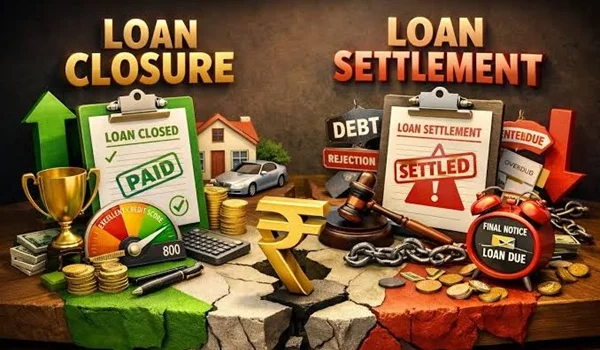
Loan closure generally means that you have repaid the entire outstanding loan amount, including applicable interest and charges. Loan settlement means that the lender has agreed to accept an amount lower than the total amount due and waive or write off the remaining balance, subject to the settlement agreement.
Loan closure is generally better for your credit profile, while loan settlement can negatively affect your future borrowing eligibility.
This article explains the difference between loan settlement and loan closure, their impact on CIBIL scores, benefits, disadvantages, and what borrowers should do after settling a loan.
What Is Loan Settlement?
Loan settlement is an arrangement between a borrower and a lender in which the lender agrees to accept a payment lower than the total outstanding loan amount to resolve the borrower’s repayment obligation under the agreed settlement terms.
It generally happens when a borrower is unable to repay the full loan amount because of financial difficulties.
For example, suppose you have taken a personal loan of ₹5 lakh. Due to job loss or a medical emergency, you are unable to pay the remaining EMIs.
After several missed payments, your outstanding amount increases because of applicable interest and charges.
You contact the lender and explain your financial situation. After reviewing your circumstances, the lender agrees to accept ₹2.5 lakh as a full and final settlement instead of the entire outstanding amount.
If you pay the agreed settlement amount according to the settlement terms, the lender may report the account as Settled to credit information companies.
However, the remaining amount that the lender has agreed to waive is not treated as a normal repayment.
When Should You Consider Loan Settlement?
Loan settlement may be considered when:
- You have lost your job and have no regular income.
- Your business is facing significant financial losses.
- You are dealing with unexpected medical expenses.
- You have multiple outstanding loans and cannot manage the repayments.
- You have experienced a major financial crisis.
- You are unable to repay the complete outstanding amount despite genuine efforts.
Loan settlement should generally be considered a last resort because it can negatively affect your credit profile.
What Is Loan Closure?
Loan closure means repaying the complete outstanding loan amount, including applicable principal, interest, and other charges.
Once the borrower makes the full payment, the lender closes the loan account and updates its status with the relevant credit information companies.
For example, suppose you have an outstanding personal loan of ₹2 lakh.
You arrange the required funds and pay the complete outstanding amount to the lender.
After receiving the payment, the lender updates your account status as Closed.
You may also receive a No Dues Certificate (NDC) or No Objection Certificate (NOC), confirming that no further payment is due under the loan agreement.
Types of Loan Closure
Loan closure can generally happen in two ways.
Regular Loan Closure
Regular loan closure happens when you pay all your EMIs according to the original repayment schedule.
For example, if you take a five-year personal loan and pay all 60 EMIs on time, the loan gets closed after the final instalment and adjustment of any remaining dues.
Pre-Closure or Foreclosure
Pre-closure means repaying the entire outstanding loan amount before the scheduled maturity date.
For example, if your personal loan has 18 months remaining but you have sufficient funds to repay the complete outstanding balance, you can request foreclosure from the lender.
Applicable foreclosure charges, if any, depend on the loan agreement and relevant RBI regulations.
Loan Settlement vs Loan Closure: Key Differences
Loan settlement and loan closure are different repayment outcomes. Understanding these differences is important before choosing either option.
| Comparison | Loan Settlement | Loan Closure |
| Meaning | Lender accepts less than the total amount due | Borrower repays the complete outstanding amount |
| Payment | Partial payment of total dues | Full payment of total dues |
| Remaining amount | May be waived or written off under the agreement | No remaining contractual dues |
| CIBIL status | Generally reported as Settled | Generally reported as Closed |
| Credit score impact | Usually negative | Generally favourable compared with settlement |
| Future loan eligibility | May become difficult | Generally better |
| Creditworthiness | May be viewed as a repayment risk | Shows completion of repayment |
| NOC or confirmation | Settlement confirmation | Loan closure or no-dues confirmation |
| Suitable for | Borrowers facing serious financial difficulties | Borrowers able to repay the full amount |
The main difference is that loan settlement involves an agreed payment below the total outstanding amount, whereas loan closure requires repayment of the complete amount due.
Difference Between Loan Settlement and Loan Closure: Practical Example
Consider the following example to understand how both options work.
Suppose you have a personal loan with these details:
| Loan Details | Amount |
| Original loan amount | ₹5,00,000 |
| Outstanding amount, including applicable dues | ₹3,00,000 |
| Amount offered under settlement | ₹1,80,000 |
| Remaining amount waived under settlement | ₹1,20,000 |
If You Choose Loan Settlement
The lender agrees to accept ₹1,80,000 as a settlement amount instead of the complete outstanding amount of ₹3 lakh.
You pay the agreed ₹1,80,000 according to the settlement terms.
The lender may then report the account as Settled.
Although you have resolved the account under the settlement agreement, your credit report may reflect that you did not repay the full contractual amount.
If You Choose Loan Closure
Instead of negotiating a settlement, you arrange ₹3 lakh and pay the complete outstanding amount.
The lender closes your account and reports it as Closed.
This indicates that you have fulfilled your repayment obligation.
Which Option Is Better?
| Particulars | Settlement | Closure |
| Total amount due | ₹3,00,000 | ₹3,00,000 |
| Amount paid | ₹1,80,000 | ₹3,00,000 |
| Amount waived | ₹1,20,000 | ₹0 |
| Account status | Settled | Closed |
| Credit profile | Negative impact possible | Generally more favourable |
Loan settlement reduces your immediate payment burden, but loan closure is generally better for maintaining a healthy credit history.
Loan Settlement vs Loan Closure: Impact on CIBIL Score
Your CIBIL score is an important indicator of your creditworthiness. Banks and NBFCs use your credit report and other financial information to evaluate loan applications.
The way a lender reports your loan account can influence how future lenders assess your repayment behaviour.
Impact of Loan Settlement on CIBIL Score
Loan settlement can negatively affect your CIBIL score because it indicates that the lender accepted less than the complete amount due.
When a lender reports an account as Settled, future lenders may consider it a sign of repayment difficulty.
Possible consequences include:
- Lower credit score: Your credit score may decrease depending on your existing credit history.
- Loan rejection: Banks may reject applications because of the settled account status.
- Higher interest rates: Some lenders may offer loans at less favourable interest rates.
- Reduced credit card eligibility: You may face difficulties obtaining new credit cards.
- Lower borrowing limits: Lenders may approve a smaller loan amount.
- Additional verification: Financial institutions may ask for explanations about the settlement.
According to TransUnion CIBIL, a settled account indicates that the borrower and lender agreed on an amount lower than the actual amount due. CIBIL explains that lenders may view this status as a repayment risk.
Impact of Loan Closure on CIBIL Score
Loan closure generally has a positive impact on your credit history because it shows that you have repaid the complete outstanding amount.
Its benefits include:
- Positive repayment record: It demonstrates that you fulfilled your repayment obligation.
- Better creditworthiness: Future lenders can see that the account was fully repaid.
- Improved loan eligibility: A properly closed account is generally more favourable than a settled account.
- Reduced outstanding debt: Your total outstanding loan liability decreases.
- Better financial profile: It helps maintain a responsible borrowing history.
However, closing a loan does not guarantee an immediate increase in your CIBIL score.
Your score also depends on payment history, credit utilisation, credit mix, outstanding balances, and recent credit enquiries.
How Long Does Loan Settlement Affect Your CIBIL Score?
There is no universal fixed number of months after which a settled account automatically stops affecting your CIBIL score.
A settled status can remain visible in your credit report for the applicable credit information retention period.
Its impact on future loan applications depends on several factors, including:
- The age of the settled account.
- Your overall repayment history.
- Your current credit score.
- Other active loans and credit cards.
- The number of previous defaults.
- The lender’s credit assessment policy.
Even if your CIBIL score improves over time, the historical settled status may continue to be visible in your credit report.
Therefore, borrowers should avoid settling loans simply to improve their short-term financial position without considering the long-term consequences.
Can You Convert a Settled Loan into a Closed Loan?
Yes, it may be possible to convert a settled loan account into a closed account, but it depends on the lender’s confirmation and the remaining outstanding amount.
If you have previously settled a loan and want to improve your credit report, you can contact the lender and ask whether you can pay the amount that was waived under the settlement.
Steps to Convert Settled Status into Closed Status
Contact Your Lender
Contact the bank or NBFC that settled your loan.
Explain that you want to clear the remaining waived amount and request the procedure for regularising the account.
Request the Outstanding Amount
Ask the lender to provide a written calculation of the remaining amount payable.
Do not make any additional payment without obtaining written confirmation of how it will affect your account status.
Pay the Remaining Amount
If the lender agrees, pay the amount through an authorised payment channel.
Keep the payment receipt and transaction confirmation.
Obtain a No Dues Certificate
After completing the required payment, request a No Dues Certificate or loan closure confirmation.
Check Your CIBIL Report
After the lender updates its records, check your credit report to verify whether the account status has been corrected from Settled to Closed.
If the lender has not updated the information correctly, raise a dispute with the lender and the relevant credit information company.
TransUnion CIBIL has described a case in which a borrower paid the remaining outstanding amount after settlement, obtained an NOC, and successfully got the account status updated to Closed following verification with the lender.
Important: Paying the remaining amount does not automatically guarantee a status change. The lender must verify the payment and report the correct account status.
Loan Settlement vs Loan Write-Off: What Is the Difference?
Many borrowers confuse loan settlement with loan write-off. However, both terms have different meanings.
Loan settlement happens when the lender agrees to accept a reduced amount from the borrower to resolve the outstanding dues.
Loan write-off is an accounting action in which the lender removes an amount from its books as an asset for accounting purposes.
A write-off does not automatically mean that the borrower is no longer legally responsible for repayment.
The lender may continue recovery efforts according to applicable laws and the loan agreement.
| Comparison | Loan Settlement | Loan Write-Off |
| Meaning | Agreed repayment below total dues | Accounting removal of loan amount from books |
| Borrower payment | Pays agreed settlement amount | May still owe the outstanding amount |
| Lender action | Accepts a reduced amount | Recognises the amount as a loss or removes it from its books |
| Credit report | May show Settled | May show Written-off |
| Recovery | Depends on settlement terms | Recovery may continue |
A written-off account and a settled account should not be treated as automatically equivalent to a closed loan.
What Should You Do If Your Loan Is Already Settled?
If your loan has already been settled, you should take steps to understand its current status and improve your credit profile.
Check Your Credit Report
Obtain your latest credit report and check whether the loan is reported as Settled, Written-off, or another status.
Also verify the outstanding balance and payment history.
Contact the Lender
Ask the lender whether any amount remains payable and whether the account can be regularised by paying the remaining dues.
Clear the Remaining Amount If Possible
If you can afford to pay the remaining amount and the lender agrees to update the account status, complete the payment through an authorised channel.
Collect Written Confirmation
Keep copies of the settlement letter, payment receipts, NOC, and loan closure documents.
These documents can help resolve future disputes.
Raise a Credit Report Dispute
If the lender has received the complete payment but has reported incorrect information, raise a dispute.
The credit information company may coordinate with the lender to verify and correct the account details.
How to Improve Your CIBIL Score After Loan Settlement
A settled loan can affect your credit profile, but you can still work towards improving your creditworthiness.
Consider the following steps.
Pay All Existing EMIs on Time
Make sure you pay all active loan EMIs before their due dates.
A consistent repayment history helps demonstrate responsible credit behaviour.
Maintain Low Credit Card Utilisation
Avoid using your entire credit card limit every month.
Try to keep your credit utilisation at a reasonable level.
For example, if your credit card limit is ₹1 lakh, regularly using ₹20,000 to ₹30,000 may help keep utilisation relatively low.
Avoid Multiple Loan Applications
Applying for several loans or credit cards within a short period can create multiple hard enquiries on your credit report.
Apply for credit only when necessary.
Maintain a Healthy Credit Mix
A balanced combination of secured and unsecured credit can contribute to your credit profile, provided you can manage the repayments comfortably.
Do not take unnecessary loans merely to improve your credit mix.
Check Your Credit Report Regularly
Review your credit report to identify incorrect account balances, payment entries, or settled and closed statuses.
Raise disputes if you find inaccurate information.
Avoid Repeated Defaults
One of the most important ways to improve your creditworthiness is to avoid missing future loan payments.
Build a repayment budget that matches your monthly income and expenses.
Important Documents to Collect After Loan Settlement or Closure
Whether you settle or close a loan, maintaining proper documentation is important.
The documents you should collect include:
| Document | Purpose |
| Settlement Letter | Confirms the agreed settlement amount and conditions |
| Payment Receipt | Provides proof of the amount paid |
| Loan Closure Letter | Confirms that the loan account has been closed |
| No Dues Certificate (NDC) | Confirms that no further dues remain under the applicable arrangement |
| No Objection Certificate (NOC) | Provides confirmation from the lender |
| Updated Loan Statement | Shows the final payment and account balance |
For a settled loan, ensure that the settlement letter clearly explains the amount accepted and the treatment of the remaining dues.
For a closed loan, ensure that the lender confirms that the complete contractual amount has been paid.
Common Mistakes to Avoid During Loan Settlement
Borrowers sometimes make mistakes while negotiating a loan settlement. These mistakes can create further financial and legal complications.
Avoid the following:
- Accepting verbal settlement offers: Always request written confirmation from the lender.
- Paying without checking the settlement terms: Understand the exact amount and payment deadline.
- Ignoring the CIBIL impact: Remember that settlement can negatively affect future borrowing eligibility.
- Not collecting payment receipts: Maintain proof of every transaction.
- Assuming a settled loan is closed: Check the exact account status in your credit report.
- Ignoring remaining dues: Understand whether the lender has waived the balance or whether any amount remains payable.
- Making payments to unauthorised agents: Use only authorised payment methods and lender-approved channels.
Frequently Asked Questions (FAQs)
Is loan settlement better than loan closure?
No. Loan closure is generally better because it indicates that you have repaid the entire outstanding amount. Loan settlement indicates that the lender accepted less than the total amount due, which can negatively affect your credit profile.
Does loan settlement reduce your CIBIL score?
Yes, loan settlement can negatively affect your CIBIL score. However, the exact reduction depends on your existing credit history and other scoring factors.
How many years does a settled loan stay on your CIBIL report?
There is no simple universal expiry period after which a settled account automatically disappears. The account remains subject to applicable credit information retention rules and reporting practices.
Can I get a personal loan after loan settlement?
Yes, it is possible, but approval may become difficult. Lenders may consider your settled account a negative repayment indicator and may reject your application or offer less favourable terms.
Can I remove settled status from my CIBIL report?
You cannot simply request the credit bureau to remove accurate settlement information. However, if you subsequently pay the remaining amount and the lender agrees to report the account as Closed, the lender can update the status. Incorrect reporting can also be disputed.
Does loan closure increase CIBIL score immediately?
No. Loan closure does not guarantee an immediate increase in your CIBIL score. Its impact depends on your overall credit profile and the lender’s reporting.
Is loan settlement legally valid in India?
Yes. A loan settlement is a valid arrangement when properly agreed upon between the borrower and lender. The borrower should obtain written confirmation specifying the settlement amount, payment terms, and treatment of the remaining dues.
Can a bank reject my loan application because of a settled account?
Yes. A bank may reject a loan application after reviewing a settled account in your credit report. However, the decision depends on its internal credit policy and your overall financial profile.
What is the difference between settled and closed status in CIBIL?
Settled means the lender accepted an amount lower than the total outstanding dues. Closed means the borrower repaid the complete amount due and the account was closed.
Should I settle my loan if I cannot afford the EMI?
Loan settlement may be considered if you are facing serious financial difficulties and cannot repay the full outstanding amount. However, first discuss alternatives such as restructuring, revised repayment schedules, or temporary repayment arrangements with your lender.
Conclusion
Loan settlement and loan closure may both resolve an outstanding loan account, but their impact on your financial future is different.
Loan closure is generally the better option because it shows that you have repaid the complete outstanding amount and fulfilled your repayment obligation. It helps maintain a more favourable credit history and can support future loan eligibility.
Loan settlement can provide temporary financial relief when you are unable to repay the complete loan amount. However, the Settled status may negatively affect your CIBIL score and make future borrowing more difficult.
Before choosing loan settlement, explore other repayment options and discuss your financial difficulties with the lender.
If you can afford to repay the complete outstanding amount, prefer loan closure over loan settlement. Always collect written confirmation, payment receipts, and the applicable NOC or No Dues Certificate to protect your financial records.