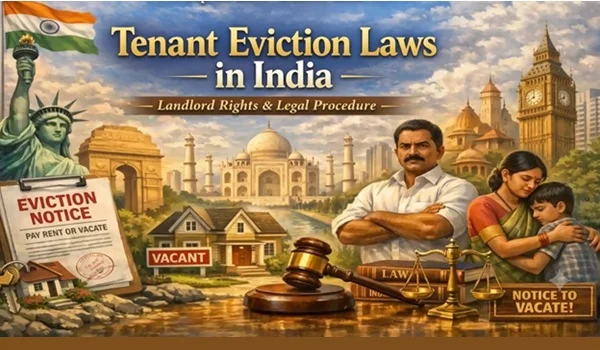
Renting a house, flat, shop or commercial property creates legal rights and responsibilities for both the landlord and the tenant. A landlord owns the property, but ownership does not give the landlord an unlimited right to remove a tenant whenever they want. Similarly, a tenant cannot claim permanent possession simply because they have occupied a property for many years.
In India, tenant eviction is mainly governed by the Transfer of Property Act, 1882, state-specific Rent Control Acts, applicable tenancy laws and the rental agreement. The exact rules depend on the state, type of property, rent amount, nature of tenancy and reason for eviction.
A landlord may legally seek eviction for reasons such as non-payment of rent, unauthorised subletting, misuse of property, genuine personal requirement or expiry and lawful termination of the tenancy. However, the landlord must follow the correct legal procedure.
What Are the Tenant Eviction Rules in India?
There is no single eviction law that applies in exactly the same way across all Indian states. Different states have their own rent control laws, and some properties may fall outside the protection of those laws.
For many tenancies, the Transfer of Property Act, 1882 (TPA) provides the general rules for ending a lease. Where a state Rent Control Act applies, the landlord may have to establish one or more specific statutory grounds before the tenant can be evicted.
The rental agreement is also important. It may specify:
- Tenancy period and renewal conditions
- Monthly rent and payment date
- Security deposit
- Notice period
- Permitted use of the property
- Rules regarding subletting
- Responsibilities for repairs and maintenance
- Conditions for termination
A landlord must follow the applicable law even if the rental agreement contains a clause that appears to allow immediate eviction.
When Can a Landlord Legally Evict a Tenant in India?
The grounds for eviction vary by state, but the following are common reasons recognised under different tenancy and rent control laws.
Non-Payment of Rent
Non-payment of rent is one of the most common reasons for eviction.
If a tenant regularly fails to pay rent despite receiving reminders or a formal demand notice, the landlord may start eviction proceedings under the applicable law.
However, the landlord may need to:
- Establish the amount of unpaid rent.
- Serve a valid demand notice.
- Give the tenant the legally required opportunity to clear the arrears, where applicable.
- File an eviction case before the competent court or Rent Controller if the tenant does not comply.
Some state laws allow tenants to avoid eviction by paying the legally recoverable arrears within the prescribed period. The exact conditions and time limits differ.
Expiry of the Rental Agreement
A landlord may seek possession when a fixed-term rental agreement expires and is not renewed.
Section 111 of the Transfer of Property Act, 1882, recognises the expiry of the agreed lease period as one way in which a lease determines.
However, the landlord should check whether the tenant has a right to continue under a specific state law or whether a new tenancy has been created through the parties’ conduct.
Expiry of the agreement does not authorise the landlord to use force or remove the tenant’s belongings. If the tenant refuses to vacate, the landlord may need to approach the appropriate legal forum.
Genuine Personal Requirement
A landlord may seek eviction if the property is genuinely required for personal use or for the needs of dependent family members.
For example:
- The landlord wants to move into the rented house.
- The property is required for a dependent son or daughter.
- The landlord needs the premises for a genuine business purpose.
- The landlord has no reasonably suitable alternative property.
This ground is commonly recognised under state Rent Control Acts, but the legal test differs from one state to another.
The landlord may have to prove that the requirement is genuine and not merely a reason created to remove the tenant.
Unauthorised Subletting
A tenant generally cannot sublet the entire property or a part of it without the landlord’s consent where the agreement or applicable law requires such permission.
Examples include:
- Renting a room to another person without permission.
- Giving possession of the flat to someone else.
- Allowing another business to operate from the premises without approval.
- Transferring possession to a third party without the landlord’s consent.
Unauthorised subletting or transfer of possession can become a valid ground for eviction under many state tenancy laws.
However, simply allowing a family member or guest to stay does not automatically amount to unlawful subletting. The facts and applicable law must be examined.
Misuse of the Rented Property
A tenant must use the property according to the permitted purpose and applicable laws.
For example, a landlord may have grounds to seek eviction if a tenant:
- Uses a residential property for an unauthorised commercial activity.
- Conducts illegal activities from the premises.
- Causes serious damage to the property.
- Creates a continuing nuisance for neighbours.
- Makes unauthorised structural changes.
- Uses the property in a way prohibited by the rental agreement or law.
In some situations, the landlord must first issue a notice asking the tenant to stop the misuse. Eviction may become possible if the tenant continues the prohibited activity.
Unauthorised Structural Changes
A tenant cannot normally make major structural changes without the landlord’s permission.
Examples may include:
- Removing important walls.
- Changing the building’s structure.
- Making unauthorised permanent additions.
- Damaging essential fixtures.
- Carrying out alterations that affect the safety of the building.
Ordinary repairs and minor changes may be treated differently. The rental agreement and applicable state law determine what permission is required.
Property Required for Major Repairs or Reconstruction
A landlord may seek possession if the building has become unsafe or requires major repairs, demolition or reconstruction that cannot reasonably be completed while the tenant remains in occupation.
The landlord may need to provide evidence such as:
- Structural safety reports.
- Repair or reconstruction plans.
- Permission from the local authority, where required.
- Evidence that the work cannot be carried out without vacant possession.
Some state laws also provide specific rights to tenants after reconstruction, including rights relating to re-entry or alternative accommodation. These protections must be checked under the applicable law.
Important Laws Governing Tenant Eviction in India
The legal framework depends on the location and type of tenancy. The following laws are particularly important.
| Law | Relevance to Tenant Eviction |
| Transfer of Property Act, 1882 | General rules for termination of leases and landlord-tenant relationships |
| State Rent Control Acts | Special grounds and procedures for eviction in covered properties |
| Model Tenancy Act, 2021 | Model framework for tenancy regulation that states and Union Territories may adopt |
| Code of Civil Procedure, 1908 | Civil court procedure and enforcement of court decrees |
| Indian Contract Act, 1872 | Relevant contractual principles governing rental agreements |
The Model Tenancy Act, 2021 is not automatically applicable throughout India. States and Union Territories must adopt or implement the model framework through their own legal measures. Therefore, a landlord or tenant should not assume that its provisions apply to every rental property.
What Is the Notice Period for Evicting a Tenant?
The notice period depends on the rental agreement and the law applicable to the property.
Under Section 106 of the Transfer of Property Act, 1882, where there is no contrary contract, local law or usage:
- A lease for agricultural or manufacturing purposes is generally treated as a year-to-year lease, terminable by six months’ notice.
- A lease for any other purpose is generally treated as a month-to-month lease, terminable by 15 days’ notice.
The notice must be in writing and served in the manner recognised by law.
However, these are general rules. A rental agreement or state-specific tenancy law may prescribe different requirements. Rent Control Acts may also require a particular statutory ground and procedure before eviction can take place.
A 15-day notice does not mean that every tenant in India can be evicted within 15 days. It is important to check which law governs the tenancy.
Legal Process to Evict a Tenant in India
A landlord should follow the proper legal procedure instead of trying to remove the tenant personally.
Review the Rental Agreement
The landlord should first examine the rental agreement to understand:
- Tenancy duration.
- Rent payment conditions.
- Notice period.
- Termination clauses.
- Rules regarding subletting.
- Conditions relating to property damage or misuse.
The landlord should also identify whether the property is covered by a state Rent Control Act.
Identify a Valid Reason for Eviction
The landlord must identify a legally recognised ground for seeking possession.
Depending on the applicable law, this may include unpaid rent, unauthorised subletting, misuse, genuine personal requirement or expiry of the tenancy.
A landlord should not use a false reason to force a tenant out.
Send a Legal Eviction Notice
The landlord should send a written notice to the tenant explaining:
- Name and address of the landlord and tenant.
- Details of the rented property.
- Reason for termination or eviction.
- Details of unpaid rent, if applicable.
- Applicable notice period.
- Date by which the tenant is expected to vacate.
- Any action required from the tenant.
The notice should be served through a legally recognised method. The landlord should preserve a copy and proof of delivery.
File an Eviction Case
If the tenant does not vacate after the required notice or fails to comply with the applicable legal requirements, the landlord may approach the competent authority.
Depending on the law, the matter may be filed before:
- Rent Controller.
- Rent Court or Rent Authority, where established under applicable law.
- Civil Court.
The landlord must submit the required application or plaint and supporting documents.
Attend the Court Proceedings
The court or authority gives the tenant an opportunity to respond.
Both parties may submit evidence and arguments. The landlord must establish the legal grounds for eviction.
The tenant can challenge the allegations, produce rent payment records and raise any legal defence available under the applicable law.
Obtain and Enforce the Eviction Order
If the court or competent authority decides in favour of the landlord, it may pass an eviction or possession order.
If the tenant still refuses to vacate, the landlord may need to apply for execution of the order through the legal process.
A landlord should not personally enforce an eviction order by using force, changing locks or removing the tenant’s belongings.
Can a Landlord Evict a Tenant Without Going to Court?
Generally, a landlord cannot forcibly remove a tenant simply by giving a notice.
A landlord may lawfully end a tenancy by following the applicable termination procedure. However, if the tenant refuses to hand over possession, the landlord usually needs an order from the competent court or authority to recover possession.
There may be situations where a tenant voluntarily vacates after receiving a valid termination notice. In that case, separate eviction proceedings may not be necessary.
But a landlord should not:
- Change the door locks to prevent the tenant from entering.
- Remove furniture or personal belongings.
- Disconnect electricity or water to force the tenant out.
- Threaten or physically intimidate the tenant.
- Enter the premises unlawfully.
- Use private security personnel to remove the tenant.
Such actions can lead to legal disputes and possible civil or criminal consequences.
Can a Landlord Evict a Tenant for Not Paying Rent?
Yes. Non-payment of rent can be a valid ground for eviction.
However, the landlord must follow the procedure prescribed by the applicable tenancy law.
For example, under some Rent Control Acts, the landlord must serve a demand notice and give the tenant a specified period to clear the legally recoverable arrears.
The tenant should maintain evidence of rent payments, including:
- Bank transfer records.
- UPI payment confirmations.
- Rent receipts.
- Written communication with the landlord.
- Records of any rent deposited through a legally permitted procedure.
If the landlord refuses to accept rent, the tenant should seek legal advice about the correct method of payment or deposit. Simply keeping the rent unpaid may weaken the tenant’s position.
Can a Landlord Evict a Tenant Before the Agreement Ends?
A landlord generally cannot terminate a fixed-term tenancy in violation of the rental agreement or applicable law.
However, early termination may be possible in certain circumstances, such as:
- A valid termination clause is triggered.
- The tenant commits a serious breach of the agreement.
- The tenant fails to pay rent.
- The tenant carries out unauthorised subletting.
- A specific statutory ground for eviction is established.
- The parties mutually agree to end the tenancy.
The landlord must still follow the required legal procedure. A clause in the agreement does not automatically permit forced eviction.
Tenant Rights Against Illegal Eviction in India
Indian laws provide protection against arbitrary eviction. A tenant can take legal action if a landlord attempts to remove them unlawfully.
Important tenant rights include:
Right to Follow Due Legal Process
A tenant cannot ordinarily be removed by force merely because the landlord owns the property.
If the tenant disputes the eviction, the landlord must use the legal remedy available under the applicable law.
Right to Receive Proper Notice
Where the law or agreement requires notice, the tenant is entitled to receive it in the prescribed manner.
The tenant should read the notice carefully and respond within the applicable period.
Right to Challenge an Unlawful Eviction
A tenant may challenge eviction proceedings if:
- The landlord has no valid legal ground.
- The notice does not comply with applicable requirements.
- The landlord has not followed the prescribed procedure.
- The eviction claim is based on incorrect facts.
- The tenant has a valid defence under the Rent Control Act or rental agreement.
Right Against Harassment
A landlord should not use threats, intimidation, illegal entry or disruption of essential services to force a tenant to vacate.
Depending on the facts, a tenant may seek an injunction or other appropriate relief from a court.
Right to Recover the Security Deposit
The security deposit should be settled according to the rental agreement and applicable law.
The landlord may deduct legitimate outstanding rent, unpaid bills or proven damage where permitted. However, the landlord should not withhold the entire deposit without a valid basis.
What Should a Tenant Do If the Landlord Tries to Evict Them Illegally?
If a landlord attempts to forcefully remove a tenant, the tenant should take the following steps:
- Keep all documents: Preserve the rental agreement, rent receipts, payment records and messages.
- Save evidence: Keep photographs, videos, call records and written communication relating to threats or illegal entry.
- Respond to legal notices: Do not ignore an eviction notice or court summons.
- Send a written objection: Explain why the proposed eviction is disputed, if there are valid grounds.
- Seek an injunction: A tenant may approach the appropriate court for protection against unlawful interference with possession.
- Contact the police: If there are threats, violence, forced entry or damage to property, the tenant may approach the police.
The correct remedy depends on the nature of the landlord’s conduct and the applicable tenancy law.
Tenant Eviction Rules in Different Indian States
Different states have separate laws governing rent and eviction. Some important examples are:
| State/UT | Important Rent Control Law |
| Delhi | Delhi Rent Control Act, 1958 |
| Maharashtra | Maharashtra Rent Control Act, 1999 |
| Tamil Nadu | Tamil Nadu Regulation of Rights and Responsibilities of Landlords and Tenants Act, 2017 |
| Karnataka | Karnataka Rent Act, 1999 |
| West Bengal | West Bengal Premises Tenancy Act, 1997 |
| Uttar Pradesh | Uttar Pradesh Regulation of Urban Premises Tenancy Act, 2021 |
| Haryana | Haryana Urban (Control of Rent and Eviction) Act, 1973 |
The applicability of these laws depends on factors such as the type of premises, location, rent, statutory exemptions and other conditions.
For example, Section 14 of the Delhi Rent Control Act, 1958, provides protection against eviction except on specified grounds. The Haryana Rent Act also contains provisions regulating eviction from covered premises.
The eviction rules applicable to a residential flat in one state may be different from those applicable to a commercial shop in another state.
Difference Between Termination of Tenancy and Eviction
These terms are related but have different legal meanings.
| Basis | Termination of Tenancy | Eviction |
| Meaning | Legally ending the tenancy | Recovering possession from the tenant |
| Process | May happen through expiry, notice or another valid legal ground | Usually requires proceedings if the tenant refuses to leave |
| Authority | May be done through a valid contractual or statutory procedure | Court or competent authority may order possession |
| Tenant’s position | Tenant may still physically occupy the property | Tenant is required to surrender possession under the applicable order |
| Legal effect | Tenancy rights come to an end | Possession is recovered through the lawful process |
Ending a tenancy and physically recovering possession are not always the same thing. If a tenant does not leave voluntarily, the landlord should follow the legal process to recover the property.
Documents Required for Filing an Eviction Case
A landlord may need the following documents, depending on the applicable law and nature of the case:
| Document | Purpose |
| Rental agreement | Establishes the tenancy terms |
| Ownership documents | Shows the landlord’s interest in the property |
| Rent payment records | Helps establish unpaid rent or payment history |
| Legal notice | Shows that the required notice was served |
| Delivery proof | Establishes service of the notice |
| Communication records | Supports allegations of breach or misuse |
| Photographs or inspection reports | May establish property damage |
| Identity and address proof | Identifies the parties |
| Other supporting documents | Helps prove the specific ground for eviction |
The exact list may differ depending on the court, Rent Controller or authority handling the matter.
How Long Does It Take to Evict a Tenant in India?
There is no fixed timeline for every eviction case.
Some matters may be resolved relatively quickly, while others can take several months or years.
The duration depends on:
- Applicable state tenancy law.
- Type of eviction ground.
- Whether the tenant contests the case.
- Availability of evidence.
- Court workload.
- Adjournments and procedural requirements.
- Appeals or challenges.
- Time required to execute the final order.
Cases involving complicated ownership disputes, disputed rent payments or multiple legal proceedings may take longer.
A landlord should not promise that a tenant can be legally evicted within a fixed number of days simply by issuing a notice.
Frequently Asked Questions About Tenant Eviction Rules in India
Can a landlord evict a tenant without giving notice?
The requirement for notice depends on the applicable law and rental agreement. Where notice is legally required, the landlord must follow the prescribed procedure. A landlord cannot use force to remove a tenant.
Can a landlord evict a tenant after the rental agreement expires?
Yes, the landlord may seek possession after the fixed tenancy period ends, subject to applicable state law and any continuing tenancy rights. If the tenant refuses to vacate, the landlord may need to approach the competent court or authority.
Can a landlord evict a tenant for one month of unpaid rent?
It depends on the applicable law and agreement. One month’s unpaid rent does not automatically result in eviction in every state. Some laws require a particular period of default and service of a demand notice.
Can a landlord increase rent and evict a tenant if they refuse?
A landlord cannot automatically evict a tenant merely because the tenant refuses an unlawful rent increase. Rent increases must comply with the agreement and applicable tenancy law. If the tenant refuses a legally payable rent, the landlord may have remedies under the relevant law.
Can a landlord enter a rented house without permission?
A landlord does not have an unrestricted right to enter an occupied rented property. Entry should follow the rental agreement and applicable law, including any requirements for prior notice or consent. Emergency situations may be treated differently.
Can a tenant refuse to leave after receiving an eviction notice?
A tenant may dispute an eviction notice if there are valid legal grounds. However, ignoring a valid notice or court proceedings can create legal difficulties. The tenant should respond appropriately and seek legal advice.
Can a landlord cut electricity or water to evict a tenant?
A landlord should not disconnect essential services to force a tenant to vacate. Depending on the applicable law and circumstances, the tenant may seek legal protection or approach the relevant authorities.
Can a landlord evict a tenant for keeping a pet?
It depends on the rental agreement, applicable housing rules and the facts. Keeping a pet is not automatically a valid eviction ground in every situation. A dispute may arise if the tenant violates a valid agreement condition or causes damage or serious nuisance.
Does a tenant have rights if there is no written rental agreement?
Yes. The absence of a written agreement does not automatically remove all tenant rights. The tenancy may be established through rent payments, possession, receipts, messages and other evidence. The applicable law determines the rights and termination procedure.
Conclusion
Tenant eviction in India must follow the applicable tenancy law, rental agreement and legal procedure. A landlord may seek eviction for valid reasons such as non-payment of rent, unauthorised subletting, misuse of property, genuine personal requirement or expiry of the tenancy.
However, a landlord cannot legally force a tenant out simply by changing locks, removing belongings, threatening the tenant or cutting essential services. If the tenant refuses to vacate, the landlord should approach the competent court or authority and obtain the appropriate order.
Tenants should also understand their responsibilities, pay rent on time, follow the agreement and respond to legal notices. Since eviction rules differ across states, both landlords and tenants should obtain advice based on the location and type of property.
Disclaimer: This article provides general legal information and is not a substitute for advice from a qualified lawyer. The applicable law, statutory exemptions and eviction procedure should be checked for the specific property and tenancy.