Taking a loan is a common way to manage financial requirements such as buying a house, purchasing a vehicle, paying education fees, managing medical expenses, or meeting personal needs. However, borrowing money also creates a responsibility to repay the loan through Equated Monthly Instalments (EMIs) on time.
Sometimes, borrowers miss an EMI because of insufficient bank balance, salary delays, job loss, unexpected expenses, or technical problems with automatic payments. Although missing one EMI may seem like a small mistake, it can have financial consequences.
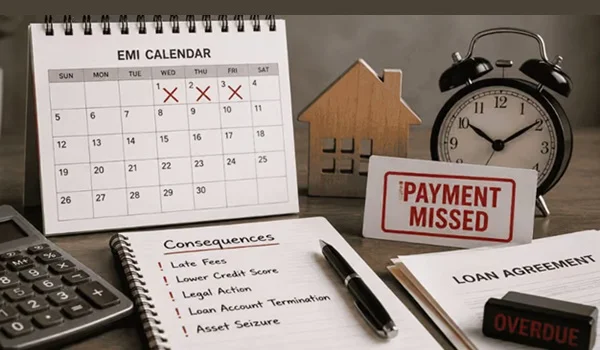
Missing an EMI payment can result in late payment charges, penal charges, additional interest, and a negative impact on your credit score. If payments remain overdue for a longer period, the lender may take further recovery action according to the loan agreement and applicable laws.
Understanding what happens after missing an EMI can help borrowers avoid unnecessary penalties and protect their credit history.
This article explains the penalties, consequences, credit score impact, recovery process, and steps to take if you miss an EMI payment in India.
What Is an EMI Payment Default?
An EMI payment default occurs when a borrower fails to pay the scheduled loan instalment by its due date.
When you take a loan from a bank or Non-Banking Financial Company (NBFC), the lender provides a repayment schedule. This schedule mentions the EMI amount, due date, interest rate, and loan tenure.
For example, suppose you have a personal loan with a monthly EMI of ₹12,000, payable on the 5th of every month.
If you do not pay the EMI by the due date, the instalment becomes overdue. The lender may charge applicable penalties and report the missed payment to credit information companies.
An EMI default does not necessarily mean that your entire loan becomes immediately payable. However, continued non-payment can lead to serious consequences depending on the loan terms and the duration of the overdue amount.
What Happens Immediately After Missing an EMI?
The consequences of missing an EMI can begin soon after the payment due date.
The exact process depends on the lender’s policies, loan agreement, and applicable regulations.
Here is what generally happens.
Late Payment Charges May Apply
If you fail to pay your EMI on time, the lender may impose applicable late payment or penal charges.
These charges increase your repayment burden and may be added to the outstanding amount.
Auto-Debit Payment May Fail
Many borrowers use NACH, ECS, or standing instructions to pay EMIs automatically from their bank accounts.
If the account does not have sufficient funds on the due date, the automatic debit may fail.
Your bank may also charge a return or bounce fee, depending on its terms and conditions.
The Lender May Send Payment Reminders
Banks and NBFCs generally send reminders through SMS, email, phone calls, or mobile applications.
These reminders inform borrowers about the overdue EMI and request payment.
Your Credit History May Be Affected
If the overdue payment is reported to credit information companies, it can negatively affect your credit profile.
The impact depends on the reporting date, payment status, and other details in your credit history.
Recovery Follow-Ups May Begin
If the EMI remains unpaid, the lender may contact you to request repayment.
For longer overdue periods, the lender may initiate formal recovery procedures in accordance with applicable laws and RBI guidelines.
What Penalties Are Charged for Missing an EMI in India?
The penalties for missing an EMI vary depending on the lender, loan category, and repayment agreement.
There is no single fixed penalty applicable to every bank or NBFC in India.
Common charges include the following.
Late Payment or Penal Charges
A lender may charge penal charges when a borrower fails to comply with the repayment terms.
Under RBI guidelines, these charges must be reasonable and consistent with the lender’s approved policy.
For loans covered by the RBI’s penal charges framework:
- Penal charges must not be added to the loan interest rate as penal interest.
- No further interest can be calculated on penal charges.
- Penal charges should apply to the amount in default.
- The lender must disclose the amount and reason for the charges in the loan agreement and Key Fact Statement (KFS).
- The lender must communicate applicable penal charges when sending reminders.
Important: RBI has not prescribed one universal rupee amount or percentage for missed EMI penalties. The applicable amount depends on the lender’s disclosed policy.
EMI Bounce Charges
If an EMI payment fails because of insufficient bank balance or another payment-related issue, the bank may impose a return or bounce charge.
For example, if your monthly EMI is ₹10,000 and your bank charges ₹500 for a failed auto-debit transaction, you may have to pay the EMI along with the applicable charges.
The lender may also impose its own applicable penal charges.
Additional Interest on Overdue Amount
If an EMI remains unpaid, the lender may continue charging interest on the overdue amount at the contracted rate, according to the loan agreement and applicable rules.
However, lenders covered by the RBI penal charges framework cannot charge additional penal interest by increasing the contractual interest rate as a penalty.
This distinction is important because regular contractual interest and penal charges are treated differently.
GST on Applicable Charges
GST may apply to certain banking and financial service charges, depending on their tax treatment.
Check your loan statement to understand whether GST has been added to any applicable service or payment-related charges.
How Does Missing an EMI Affect Your CIBIL Score?
One of the biggest consequences of missing an EMI is its potential impact on your credit score.
Credit information companies such as CIBIL maintain credit records based on information received from banks and financial institutions.
When a lender reports a missed or overdue EMI, the payment status may appear in your credit report.
Your Credit Score May Decrease
Payment history is an important factor in credit scoring.
If you miss an EMI and the lender reports the overdue payment, your credit score may decrease.
The exact impact depends on your existing credit history, repayment behaviour, overdue amount, and other credit-related factors.
Your Credit Report May Show Payment Delays
Your credit report may contain information about delayed payments and overdue accounts.
For example, payment status may indicate that an instalment has remained overdue for a particular number of days.
Repeated missed payments can make your credit profile appear riskier to potential lenders.
Future Loan Applications May Become Difficult
Banks and NBFCs generally review credit reports when evaluating loan applications.
If your credit report shows repeated payment delays, lenders may:
- Reject your loan application.
- Offer a lower loan amount.
- Charge a higher interest rate.
- Require additional income or financial documents.
- Apply stricter eligibility conditions.
Credit Card Applications May Also Be Affected
A poor repayment history can affect your eligibility for new credit cards.
Banks may consider your existing loan repayment behaviour before approving a credit card application.
Remember: Paying an overdue EMI later does not automatically erase the earlier payment delay from your credit history. The lender must update the account information accurately.
How Many Days Can You Delay an EMI Without Serious Consequences?
There is no universal grace period during which missing an EMI is guaranteed to have no consequences.
The lender’s repayment terms determine when an instalment becomes overdue and when applicable charges may be imposed.
However, overdue periods are important for understanding the seriousness of a loan default.
| Overdue Period | Possible Consequences |
| 1–30 days | Late payment charges, reminders and overdue interest as applicable |
| 31–60 days | Further recovery reminders and worsening credit history |
| 61–90 days | More serious overdue status and increased recovery follow-ups |
| More than 90 days | A term loan may generally be classified as an NPA, subject to applicable RBI norms |
The 90-day period is particularly important. Under RBI’s prudential norms, a term loan is generally classified as a Non-Performing Asset (NPA) when principal or interest remains overdue for more than 90 days.
This classification does not mean that every loan automatically becomes an NPA after exactly 90 calendar days from the original EMI date. The applicable overdue calculation and regulatory rules must be considered.
What Is NPA in a Loan Account?
NPA stands for Non-Performing Asset.
It refers to a loan account where the borrower has failed to make the required principal or interest payments for the prescribed period.
Once an account is classified as an NPA, the lender may take additional recovery steps according to applicable regulations and the loan agreement.
An NPA classification can also make it significantly more difficult for a borrower to obtain new credit.
What Happens If You Miss One EMI?
Missing one EMI does not automatically mean that your loan will be classified as an NPA or that legal action will begin immediately.
However, it can still create financial and credit-related problems.
Consider the following example:
Suppose you have a personal loan with an EMI of ₹15,000, payable on the 10th of every month.
Due to a salary delay, you fail to pay the EMI on the scheduled date.
The possible consequences include:
- The lender marks the instalment as overdue.
- Your automatic payment may be attempted again, depending on the payment arrangement.
- The bank may charge a payment return fee if the auto-debit fails.
- The lender may impose applicable penal charges.
- The lender may send payment reminders.
- The overdue payment may be reported to credit information companies.
If you pay the overdue EMI quickly, you can prevent the delay from continuing and reduce further financial consequences.
However, the payment delay may still be reflected in your credit history if it has already been reported.
What Happens If You Miss Two or Three EMIs?
Missing multiple consecutive EMIs is more serious than missing a single instalment.
When two or three EMIs remain unpaid, the outstanding overdue amount increases.
For example:
| Particulars | Amount |
| Monthly EMI | ₹15,000 |
| One missed EMI | ₹15,000 |
| Two missed EMIs | ₹30,000 |
| Three missed EMIs | ₹45,000 |
The table excludes interest, penal charges, GST and other applicable fees.
The lender may take the following steps:
- Increase the frequency of payment reminders.
- Contact you through its recovery department.
- Send formal notices requesting payment.
- Report the overdue status to credit information companies.
- Initiate recovery proceedings if the default continues and legal requirements are satisfied.
If you have missed multiple EMIs, contact the lender rather than ignoring calls and reminders.
What Happens If You Miss a Home Loan EMI?
Missing a home loan EMI can have serious consequences because the property is generally provided as security for the loan.
If you fail to repay the loan for an extended period, the lender may classify the account as an NPA and initiate recovery proceedings.
For eligible secured loans, lenders may use the Securitisation and Reconstruction of Financial Assets and Enforcement of Security Interest (SARFAESI) Act, 2002, subject to its applicability and legal requirements.
The general process may include:
- The loan account becomes overdue.
- The lender sends payment reminders.
- The account may be classified as an NPA.
- A demand notice under Section 13(2) of the SARFAESI Act may be issued where applicable.
- The borrower generally receives 60 days to repay the specified outstanding amount.
- If the borrower does not comply, the lender may take further measures under Section 13(4), subject to the law.
Missing one home loan EMI does not mean that the bank can immediately take possession of your house. The lender must follow the applicable legal procedure.
What Happens If You Miss a Personal Loan EMI?
Personal loans are generally unsecured, which means they do not require property or another specific asset as collateral.
However, this does not mean that borrowers can ignore repayment obligations.
If you miss a personal loan EMI, the lender may:
- Charge applicable penal charges.
- Report the overdue payment to credit information companies.
- Contact you for repayment.
- Send formal demand or legal notices.
- Initiate appropriate legal recovery proceedings.
Unlike a secured home or vehicle loan, an unsecured personal loan does not generally give the lender an automatic right to repossess a specific asset.
However, the lender can pursue lawful recovery remedies against the borrower.
Can a Bank Take Legal Action If You Do Not Pay EMIs?
Yes. A bank or NBFC can initiate legal recovery proceedings if a borrower repeatedly fails to repay a loan.
The type of action depends on the loan agreement, security, amount outstanding, and applicable laws.
Possible recovery measures include:
Sending a Legal Notice
The lender may send a formal demand notice asking you to clear the overdue amount.
The notice may mention the outstanding balance, applicable charges, and payment deadline.
Starting Recovery Proceedings
The lender may initiate appropriate legal proceedings to recover the outstanding loan amount.
The applicable process depends on the nature of the loan and the available legal remedies.
Taking Action Against Secured Assets
For eligible secured loans, the lender may enforce its security interest under applicable laws.
For example, a lender may initiate proceedings to take possession of a mortgaged property or recover a financed vehicle, subject to the applicable legal procedure.
Appointing Recovery Agents
Banks and NBFCs may appoint authorised recovery agents to contact borrowers and facilitate repayment.
However, recovery agents cannot threaten, intimidate, publicly humiliate, or physically harass borrowers.
RBI guidelines require regulated lenders to ensure that their recovery agents follow fair practices and respect borrowers’ rights.
Can Recovery Agents Harass You for Missing an EMI?
No. Missing an EMI does not give recovery agents the right to harass or threaten borrowers.
RBI has issued guidelines to ensure fair practices during loan recovery.
Recovery agents and lenders must follow these requirements:
- They cannot use physical violence or threaten borrowers.
- They cannot publicly humiliate borrowers.
- They should not make inappropriate or threatening calls.
- They cannot contact borrowers before 8 AM or after 7 PM for recovery purposes under RBI’s recovery-agent conduct requirements.
- They must respect the privacy of borrowers and their family members.
- They should communicate professionally and follow lawful recovery procedures.
If a recovery agent behaves improperly, you can complain to the lender’s grievance redressal department.
If the complaint is not resolved satisfactorily, you may approach the RBI Integrated Ombudsman Scheme, provided your complaint falls within its scope and eligibility requirements.
What Should You Do If You Miss an EMI Payment?
If you have missed an EMI, taking timely action can help prevent further financial problems.
Follow these steps to manage the situation.
Pay the Overdue EMI as Soon as Possible
If you have sufficient funds, clear the overdue instalment immediately.
This can prevent the overdue period from increasing and help reduce additional charges.
Contact Your Bank or NBFC
Inform the lender about the reason for missing the EMI.
If your salary is delayed or you are facing temporary financial difficulties, explain your situation and ask about available repayment options.
Check the Applicable Penalties
Review your loan agreement and latest loan statement.
Check the following details:
- Overdue EMI amount.
- Penal charges.
- Bank return charges.
- Additional interest, if applicable.
- GST on applicable charges.
If you believe the lender has imposed an incorrect charge, request a written explanation.
Request a Loan Restructuring Option
If you are unable to afford your current EMI, ask the lender whether it offers restructuring or other repayment arrangements.
Depending on your eligibility and lender approval, possible options may include:
- Increasing the loan tenure.
- Reducing the monthly EMI.
- Changing the repayment schedule.
- Providing a suitable repayment arrangement for temporary financial difficulties.
Remember that restructuring may increase the total interest payable.
Maintain Sufficient Bank Balance
If you use automatic EMI payments, maintain sufficient funds in your account before the due date.
You should also check whether your NACH or ECS mandate is active.
Check Your Credit Report
After paying the overdue amount, review your credit report to check whether the lender has updated the payment status correctly.
If the information is incorrect, raise a dispute with the lender and the relevant credit information company.
How to Avoid Missing EMI Payments in the Future
Preventing missed payments is easier than dealing with penalties and credit score problems.
Here are some practical ways to manage your EMIs.
- Set up automatic payments: Use NACH or standing instructions to avoid forgetting EMI dates.
- Maintain an additional bank balance: Keep sufficient funds in your repayment account before the due date.
- Set payment reminders: Create monthly reminders a few days before your EMI date.
- Maintain an emergency fund: Keep savings for unexpected expenses or temporary income disruptions.
- Avoid excessive borrowing: Do not take loans with EMIs that are difficult to manage.
- Track your loan obligations: Maintain a record of EMI amounts, due dates, outstanding balances, and interest rates.
- Contact the lender early: If you anticipate a payment problem, contact the bank before the due date.
Does Paying an EMI Late Affect Your Future Loan Eligibility?
Yes. Delayed EMI payments can affect your future loan eligibility, particularly if the delays are repeated or remain unpaid for extended periods.
Lenders generally examine your credit history when evaluating new loan applications.
A history of missed EMIs may indicate poor repayment discipline and increase the lender’s assessment of credit risk.
This can affect your eligibility for:
- Personal loans.
- Home loans.
- Car loans.
- Business loans.
- Credit cards.
- Loan balance transfers.
However, one delayed EMI does not automatically make you ineligible for every future loan.
Lenders consider several factors, including income, employment stability, existing debt, repayment history, and credit score.
How Long Does a Missed EMI Stay on Your Credit Report?
Credit information companies maintain historical repayment information according to applicable regulations and reporting policies.
A missed EMI does not automatically disappear from your credit report immediately after you pay it.
The historical payment delay may remain visible in your credit history for the applicable retention period.
You should regularly check your credit report to ensure that the lender has correctly updated your account status.
RBI Rules for Reporting Missed EMI Payments in India
Banks and financial institutions report borrower information to credit information companies such as TransUnion CIBIL and other authorised credit bureaus.
RBI has introduced more frequent credit information reporting to improve the accuracy and timely updating of borrower records.
Credit institutions moved to fortnightly reporting from January 1, 2025. Further directions effective July 1, 2026 provide for reporting credit information as of the 9th, 16th, 23rd, and last day of each month, or at shorter intervals as mutually agreed between the credit institution and credit information company.
This means that credit information can be updated more frequently than under the earlier monthly reporting system.
Reserve Bank of India+1
For borrowers, this makes timely EMI repayment even more important.
If you miss a payment, the overdue information may be reflected in your credit history sooner than under an older monthly reporting arrangement.
Frequently Asked Questions (FAQs)
What happens if I miss one EMI in India?
If you miss one EMI, the lender may charge applicable penal charges, bank return fees, and interest on the overdue amount. Your credit score may also be affected if the delayed payment is reported to credit information companies.
Can I pay my EMI after the due date?
Yes. You can generally pay an overdue EMI after its due date. However, the lender may charge applicable penalties and interest for the delay. Contact your lender to confirm the total outstanding amount.
How much is the penalty for missing an EMI?
There is no fixed penalty applicable to every lender. The amount depends on the loan agreement and the lender’s disclosed penal charges policy. Bank return charges may also apply separately.
Will missing one EMI affect my CIBIL score?
Yes, it can affect your CIBIL score if the lender reports the delayed payment. However, the exact impact depends on your credit history and other scoring factors.
Can a bank reject my next loan application because of one missed EMI?
A bank can consider your missed EMI while evaluating a new loan application. However, one delayed payment does not automatically result in rejection. Your income, credit score, existing liabilities, and overall repayment history also matter.
Can I skip one EMI and pay double the next month?
You can request this arrangement from your lender, but you should not assume that it is automatically allowed. The missed EMI may attract applicable charges and interest. Obtain the lender’s approval before following a different repayment schedule.
Can a bank deduct money from my account if I miss an EMI?
If you have provided a valid NACH mandate or standing instruction, the lender may attempt to collect the overdue amount according to the mandate and applicable terms. Any additional recovery or debit must comply with the applicable agreement and laws.
Can I complain against a bank for excessive EMI penalties?
Yes. You can first raise a complaint with the bank’s grievance redressal department. If the issue remains unresolved or the bank does not respond within the prescribed period, you may approach the RBI Integrated Ombudsman Scheme, subject to its eligibility conditions.
Does missing an EMI affect my home loan or personal loan differently?
Yes. Missing a personal loan EMI can lead to penalties, credit score damage, and recovery proceedings. Missing a home loan EMI can have similar consequences, but continued default may also put the mortgaged property at risk under applicable recovery laws.
Can I get a loan after settling an overdue EMI?
Yes, it is possible. However, lenders may consider your previous repayment delay while assessing your application. Paying overdue EMIs improves your current account position but does not automatically remove the historical delay from your credit report.
Conclusion
Missing an EMI payment in India can create several financial problems, including late payment charges, additional interest, bank bounce fees, and a possible reduction in your CIBIL score.
Although missing one EMI does not automatically result in an NPA classification or legal action, repeated payment defaults can have serious consequences.
The best approach is to pay overdue EMIs as soon as possible, communicate with your lender, and maintain sufficient funds for future instalments.
If you are facing financial difficulties, contact your bank or NBFC and discuss suitable repayment arrangements rather than ignoring payment reminders.
Maintaining a consistent repayment history is essential for protecting your credit score, avoiding unnecessary penalties, and improving your chances of getting loans in the future.