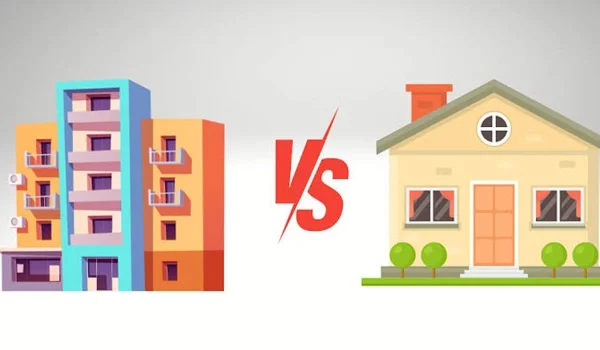
Buying a home is a major financial decision. Many buyers in India face a common question: Should they purchase an apartment in a residential society or invest in an independent house?
Both options offer different advantages. An apartment may provide better security, shared amenities and easier maintenance. An independent house offers greater privacy, more control over the property and flexibility to modify or expand the building, subject to local regulations.
However, the purchase price is only one part of the decision. Buyers should also compare maintenance expenses, land ownership, property taxes, loan requirements, rental income and long-term appreciation.
This article explains the key differences between apartments and independent houses to help buyers choose the right property according to their budget and requirements.
What Is an Apartment?
An apartment is a residential unit located within a larger building or housing complex. It generally shares common facilities and spaces with other residents.
These may include:
- Lifts and staircases
- Corridors and entrance areas
- Parking spaces
- Security systems
- Gardens and open spaces
- Clubhouses and gyms
- Swimming pools
- Water supply and other common services
Apartment owners generally have ownership rights over their individual units along with an undivided interest in the common areas and facilities, as provided under the applicable property documents and state laws.
An apartment is suitable for buyers who prefer community living, shared facilities and a comparatively structured maintenance system.
What Is an Independent House?
An independent house is a residential property that generally stands on its own plot of land rather than being one unit in a multi-storey apartment building.
Depending on the title documents and ownership structure, the owner may have rights over both the house and the underlying land.
An independent house may have:
- Private entrance
- Separate parking area
- Private garden or open space
- Multiple floors
- Terrace or rooftop
- Private water and utility arrangements, where available
- Greater flexibility for renovation
The owner is generally responsible for maintaining the building, land and services.
An independent house may be suitable for buyers who value privacy, land ownership and greater control over their residential property.
Apartment vs Independent House: Key Differences
| Comparison Point | Apartment | Independent House |
| Property structure | Unit within a larger building | Separate residential building |
| Land ownership | Generally an undivided share in common land | Usually ownership of the specific plot, subject to title |
| Privacy | Shared environment | Generally higher privacy |
| Maintenance | Shared through society or association | Owner manages maintenance |
| Security | Often has shared security arrangements | Owner arranges security |
| Amenities | May include shared facilities | Usually arranged privately |
| Customisation | Subject to society rules and structural restrictions | Generally more flexibility, subject to approvals |
| Purchase price | May be lower for a comparable location and usable area | Can be higher due to land cost |
| Monthly maintenance | Usually recurring society charges | Depends on individual expenses |
| Rental demand | Often suitable for families and working professionals | Depends on location, size and tenant requirements |
| Resale market | Depends on project, location and society condition | Depends heavily on land, location and building condition |
| Construction responsibility | Shared building maintenance | Owner is responsible for the house |
Cost Comparison: Apartment vs Independent House
The total cost of buying a home includes more than its basic purchase price.
Buyers should consider the land component, construction cost, registration expenses, taxes, maintenance and future repair requirements.
Cost of Buying an Apartment
The cost of an apartment generally depends on its location, carpet area, floor, amenities, construction quality and developer reputation.
Common expenses include:
- Basic apartment price
- Stamp duty and registration charges
- GST, if applicable
- Parking charges, where legally and contractually permissible
- Clubhouse or amenity charges
- Maintenance deposit
- Society or association charges
- Brokerage, if applicable
- Interior and furnishing expenses
- Home loan processing fees
In a ready-to-move completed property, GST is generally not applicable to the sale if the entire consideration is received after the relevant completion certificate or first occupation, whichever is earlier.
Under-construction residential properties may attract GST, subject to applicable conditions and rates.
Cost of Buying an Independent House
The price of an independent house depends significantly on the location and value of the land.
A house in an established residential area may be expensive even if the building is old because the land itself can represent a major part of the property’s value.
Common expenses include:
- Land and building purchase price
- Stamp duty and registration charges
- Legal verification expenses
- Brokerage, if applicable
- Renovation and repair costs
- Boundary wall and gate expenses
- Electrical and plumbing repairs
- Water supply arrangements
- Parking and landscaping expenses
- Property tax
- Home loan processing charges
If a buyer purchases a plot and constructs a house separately, additional expenses may include architectural fees, construction permissions, labour, building materials and contractor charges.
An independent house may involve a higher initial investment because the buyer generally acquires a specific plot of land along with the building.
Maintenance Comparison: Which Property Is Easier to Maintain?
Maintenance is an important factor because it affects the monthly household budget and the property’s long-term condition.
Apartment Maintenance
In an apartment, maintenance is generally managed by a housing society, apartment owners’ association or another authorised management body.
Residents contribute towards common expenses, which may include:
- Lift maintenance and repairs
- Security guards and CCTV systems
- Cleaning of common areas
- Garden and landscaping maintenance
- Water pumps and water supply systems
- Generator and power backup
- Common electricity bills
- Swimming pool and clubhouse maintenance
- Repairs to common plumbing and drainage systems
Maintenance charges may be calculated according to carpet area, another area-based measure, equal contribution per unit or the applicable association rules.
Some societies also collect a corpus fund or sinking fund for major repairs and future expenses.
The advantage is that residents share the cost of maintaining common facilities instead of managing every service individually. However, monthly maintenance can become expensive in projects with extensive amenities or high operating costs.
Independent House Maintenance
An independent house does not usually have a central society managing its daily maintenance.
The owner is responsible for arranging repairs and services, including:
- Roof waterproofing
- Wall painting
- Plumbing repairs
- Electrical maintenance
- Water tank cleaning
- Pest control
- Gate and boundary wall repairs
- Garden maintenance
- Drainage and sewage arrangements
- Security systems
The expenses may not be the same every month. Some months may involve very little spending, while major repairs can require a substantial amount.
For example, repairing a leaking roof, replacing electrical wiring or renovating a bathroom can increase the maintenance budget.
An independent house gives the owner more control over maintenance decisions, but the owner must manage and pay for repairs personally.
Privacy and Lifestyle Comparison
Lifestyle preferences can influence the choice between an apartment and an independent house.
Privacy in an Apartment
Apartments provide a community-based living environment. Residents share entrances, lifts, corridors, parking areas and other common facilities.
This arrangement may be convenient for people who enjoy social interaction and want access to organised amenities.
However, noise from neighbouring flats, society rules and shared spaces may reduce privacy.
Privacy in an Independent House
An independent house generally offers greater privacy because it has a separate entrance and fewer shared residential spaces.
Owners may have more control over visitors, parking, outdoor areas and daily activities.
However, privacy also depends on the plot size, neighbouring properties and the design of the house.
| Lifestyle Factor | Apartment | Independent House |
| Privacy | Comparatively limited | Generally higher |
| Neighbour interaction | More frequent | Depends on location |
| Noise | May come from nearby flats and common areas | Depends on surrounding properties |
| Private outdoor space | Limited or shared in many projects | May include a private garden or terrace |
| Community activities | Often available | Usually arranged independently |
| Rules and restrictions | Society or association rules apply | Local laws and property restrictions apply |
Security Comparison
Security is another important consideration, particularly for families with children, senior citizens or people who travel frequently.
Apartment Security
Many apartment complexes provide:
- Security guards
- CCTV cameras
- Controlled entry gates
- Visitor registration
- Intercom systems
- Security patrols
- Emergency response arrangements
These facilities may improve security, but their effectiveness depends on proper management and maintenance.
Independent House Security
In an independent house, the owner generally arranges security according to personal requirements.
Possible arrangements include:
- CCTV cameras
- Video doorbells
- Smart locks
- Boundary walls
- Security gates
- Motion sensors
- Private security personnel
The owner has greater control over security arrangements but must bear the expenses.
An apartment may offer more organised shared security, while an independent house provides flexibility to design a private security system.
Land Ownership: An Important Difference
One of the biggest differences between an apartment and an independent house is the nature of land ownership.
Land Ownership in an Apartment
An apartment buyer generally receives ownership of the individual unit along with an undivided proportionate interest in the land and common areas, depending on the applicable state law and property documents.
The buyer does not usually own a separately demarcated piece of land beneath the apartment.
For example, an apartment owner on the tenth floor may have an undivided share in the common land, even though the owner does not have exclusive possession of a particular section of the ground.
The ownership rights should be verified through the registered conveyance documents, declaration, deed of apartment and applicable state legislation.
Land Ownership in an Independent House
An independent house buyer generally acquires the house along with ownership rights over the specific plot, provided the seller has valid title to both.
This can be an important advantage because land may contribute significantly to long-term property value.
However, buyers must verify the plot’s title, boundaries, land-use permissions, access rights and any restrictions on construction.
Do not assume that every independent house automatically comes with freehold land ownership. Some properties may stand on leasehold land or be subject to specific development conditions.
Investment Comparison: Apartment vs Independent House
Both property types can be considered for long-term investment. However, their appreciation and rental potential depend on different factors.
Investment Potential of an Apartment
Apartments may be suitable for buyers looking for rental income and relatively manageable property ownership.
Factors supporting apartment investment include:
- Demand from working professionals and families
- Proximity to offices and educational institutions
- Access to public transport
- Security and shared amenities
- Demand for smaller residential units
- Availability of organised maintenance
Apartments in well-connected locations may attract tenants because they offer convenient access to daily facilities.
However, investors should consider monthly maintenance, building age, competition from other apartments and the condition of the society.
Investment Potential of an Independent House
An independent house may offer a different investment advantage because the owner generally acquires a specific plot of land.
Factors supporting its investment potential include:
- Land value appreciation
- Redevelopment possibilities, subject to approvals
- Greater flexibility in renovation
- Potential for additional floors, where legally permitted
- Demand for larger family homes
- Potential rental income from the entire house or legally usable portions
In some locations, the land component may appreciate more strongly than the building itself.
However, an old or poorly maintained house may require significant renovation expenses. Rental demand may also be lower if the property is far from employment centres or transport facilities.
Land value can be an important long-term investment factor, but appreciation is never guaranteed.
Rental Income: Which Property Is Better?
Rental income depends on the property’s location, size, condition, nearby facilities and demand from tenants.
Renting Out an Apartment
Apartments are often preferred by working professionals, small families and students, depending on the locality.
Potential advantages include:
- Easier access to common facilities
- Security arrangements
- Lift and parking facilities
- Demand near offices and business centres
- Relatively standardised layouts
However, the owner must account for society maintenance charges, vacancy periods, repairs and applicable rental rules.
Renting Out an Independent House
An independent house may attract larger families or tenants looking for more space and privacy.
Depending on its layout and local regulations, an owner may also be able to rent out separate portions of the property.
Potential advantages include:
- More living space
- Private parking
- Separate entrance
- Garden or terrace facilities
- Flexibility in rental arrangements, subject to applicable rules
However, the owner may have to manage maintenance, tenant issues and security arrangements independently.
Illustrative Rental Income Comparison
Suppose a buyer purchases an apartment and an independent house as investments.
| Particulars | Apartment | Independent House |
| Purchase price | ₹60 lakh | ₹90 lakh |
| Monthly rent | ₹20,000 | ₹30,000 |
| Annual rental income | ₹2.40 lakh | ₹3.60 lakh |
| Gross rental yield | 4% | 4% |
Gross rental yield is calculated as:
Gross Rental Yield = (Annual Rental Income ÷ Property Purchase Price) × 100
These figures are only illustrative. Actual rental yields vary significantly by location and property type.
For a better investment comparison, buyers should also deduct maintenance, property tax, repairs, insurance, vacancy losses and other ownership expenses.
Property Appreciation: Which Can Offer Better Returns?
Property appreciation means an increase in the market value of a property over time.
The appreciation of an apartment and an independent house depends on several factors.
| Factor | Apartment | Independent House |
| Land value contribution | Generally shared through undivided interest | Generally linked to the specific plot |
| Building depreciation | Can affect value as the building ages | Can affect value as the house ages |
| Location | Major influence on value | Major influence on value |
| Infrastructure development | Can improve demand | Can improve demand |
| Redevelopment | Depends on project structure and legal requirements | May offer flexibility subject to land ownership and approvals |
| Supply | New apartment projects may increase competition | Suitable plots may be limited in established areas |
| Maintenance condition | Depends partly on society management | Depends mainly on the owner |
An independent house in a well-developed area may benefit from rising land values. However, a well-maintained apartment in a strong rental location can also deliver attractive returns.
Do not choose a property only on the assumption that land prices or apartment prices will always increase. Check local demand, recent comparable transactions and future infrastructure plans.
Tax Benefits and Property-Related Taxes
Both apartments and independent houses may involve property taxes and income-tax considerations.
The applicable treatment depends on ownership, property use, loan details and the tax regime.
Municipal Property Tax
Owners of both apartments and independent houses generally have to pay property tax to the relevant municipal or local authority, where applicable.
The amount may depend on factors such as:
- Property location
- Built-up area or other assessment measure
- Property use
- Construction type
- Age of the building
- Applicable local tax rates
The calculation method differs between local authorities.
Home Loan Tax Benefits
Eligible buyers may claim certain home loan deductions under the Income-tax Act, 1961, subject to applicable conditions.
Under the old tax regime:
- Section 24(b) may allow a deduction for eligible home loan interest.
- Section 80C may allow a deduction for eligible principal repayment within the overall limit.
- Additional benefits may be available in specific cases if the relevant conditions are satisfied.
Under the new tax regime, deductions available for a self-occupied property are more restricted. The treatment of let-out property and other eligible expenses follows separate rules.
Buyers should check the tax provisions applicable to the relevant financial year before calculating the expected tax benefit.
Capital Gains Tax on Sale
If an apartment or independent house is sold at a profit, capital gains tax may apply.
The tax treatment depends on factors such as:
- Purchase date
- Sale date
- Holding period
- Purchase cost
- Eligible improvement expenses
- Applicable exemptions
- Tax rules in force for the relevant year
Both property types can qualify for relevant capital gains exemptions if the statutory conditions are satisfied.
Legal Documents to Check Before Buying an Apartment
Before purchasing an apartment, buyers should carefully verify the project’s legal and approval documents.
Important documents include:
- Registered sale deed or conveyance deed
- Title documents of the underlying land
- Agreement for sale
- Approved building plan
- Completion Certificate, where required
- Occupancy Certificate, where required
- RERA registration details, if applicable
- Encumbrance Certificate
- Property tax payment records
- Deed of apartment or relevant ownership declaration, where applicable
- Details of the undivided share in land
- Society or apartment association documents
- Maintenance dues and other outstanding charges
Buyers should also check whether the apartment has unauthorised alterations, pending litigation or unpaid utility bills.
The undivided share in land should be clearly understood before purchasing an apartment. It is an important part of the buyer’s ownership rights.
Legal Documents to Check Before Buying an Independent House
An independent house requires careful verification of both land ownership and building approvals.
Important documents include:
- Registered sale deed
- Previous ownership documents or title chain
- Encumbrance Certificate
- Land records and property identification details
- Approved building plan
- Building permission
- Completion Certificate, where required
- Occupancy Certificate, where required
- Property tax receipts
- Land-use permission
- Layout approval, where applicable
- Utility connection records
- Details of any existing mortgage or loan
Buyers should physically verify the plot boundaries and compare them with the property records and approved layout.
If the house has additional floors or extensions, check whether they have been legally approved.
An independent house with a clear-looking building but defective land title can create serious ownership problems. A proper legal title search is essential.
Common Risks of Buying an Apartment
Apartments offer convenience, but buyers should understand the possible risks.
High Society Maintenance Charges
Some residential societies charge substantial monthly maintenance because of lifts, security, clubhouses, swimming pools and other shared facilities.
These expenses can increase over time.
Poor Society Management
If the association does not manage funds properly, residents may face problems involving cleanliness, repairs, security and common facilities.
Buyers should check the society’s financial records and maintenance arrangements where possible.
Construction Quality Issues
Poor construction quality may lead to leakage, cracks, plumbing problems or other defects.
Buyers should inspect the apartment and common areas before accepting possession.
Limited Modification Rights
Apartment owners cannot make every change they want.
Structural changes, changes to common areas and certain external modifications may be restricted by building regulations, the sale documents or society rules.
Common Risks of Buying an Independent House
Independent houses offer more control but involve separate risks.
Land Title Disputes
Ownership disputes, inheritance claims, incorrect land records or defective title documents can affect the buyer’s rights.
A proper title search is essential.
Higher Repair Responsibility
The owner is responsible for arranging repairs to the roof, walls, plumbing, electrical systems, boundary walls and other parts of the house.
Major repairs can involve significant expenses.
Unauthorised Construction
Additional floors, extensions or changes in building use may violate local regulations if they are not properly approved.
Buyers should compare the actual structure with the sanctioned building plan.
Security and Utility Management
The owner may need to arrange CCTV cameras, security systems, water storage, drainage and other facilities.
These arrangements can increase ownership costs.
Apartment vs Independent House: Which Is Better for Different Buyers?
The right property depends on the buyer’s family size, budget, lifestyle and investment goals.
| Buyer Requirement | More Suitable Option |
| Smaller initial budget in many locations | Apartment |
| Shared amenities | Apartment |
| Organised common security | Apartment |
| Less individual maintenance responsibility | Apartment |
| Greater privacy | Independent house |
| Specific plot ownership | Independent house |
| Private garden or outdoor space | Independent house |
| Greater renovation flexibility | Independent house |
| Potential to use multiple floors | Independent house, subject to approvals |
| Community living | Apartment |
| Greater control over property management | Independent house |
Choose an Apartment If:
An apartment may be a better option if you:
- Have a limited or moderate property budget.
- Prefer living in a residential society.
- Want shared security and common facilities.
- Prefer organised maintenance arrangements.
- Work near an office or commercial area.
- Want a property that may be easier to rent to working professionals.
Choose an Independent House If:
An independent house may be more suitable if you:
- Have a higher purchase budget.
- Prefer privacy and more living space.
- Want ownership of a specific plot of land.
- Need private parking or outdoor space.
- Want greater flexibility for renovation.
- Can manage repairs and property maintenance.
- Plan to hold the property for a longer period.
Example: Comparing the Long-Term Ownership Cost
Consider two buyers purchasing residential properties for their families.
The following example uses illustrative figures to explain how expenses may differ.
| Expense | Apartment | Independent House |
| Purchase price | ₹60 lakh | ₹90 lakh |
| Monthly maintenance or average upkeep provision | ₹4,000 | ₹3,000 |
| Annual maintenance or upkeep | ₹48,000 | ₹36,000 |
| Annual property tax | ₹12,000 | ₹18,000 |
| Total annual maintenance and property tax | ₹60,000 | ₹54,000 |
At first glance, the independent house appears to have lower annual upkeep in this example. However, this does not include major repairs such as roof waterproofing, painting, plumbing replacement or electrical renovation.
Similarly, an apartment may require additional society contributions for major repairs, lift replacement or other common expenses.
The actual cost depends on the property’s age, size, location, construction quality and facilities.
Buyers should maintain a separate repair reserve for both property types instead of considering only the monthly maintenance amount.
Common Mistakes to Avoid While Choosing a Property
Before purchasing an apartment or independent house, avoid these common mistakes:
- Choosing a property only because its price is low.
- Ignoring the land ownership structure.
- Not checking the seller’s title documents.
- Failing to verify the approved building plan.
- Ignoring the Completion Certificate or Occupancy Certificate where required.
- Not checking property tax and maintenance dues.
- Underestimating renovation and repair expenses.
- Ignoring the neighbourhood and future infrastructure.
- Assuming that every independent house has freehold land.
- Not checking the apartment’s undivided share in land.
- Depending only on the bank’s loan approval for legal verification.
- Not calculating the expected rental yield.
It is advisable to consult an independent property lawyer and, where necessary, a technical professional before completing the purchase.
Frequently Asked Questions (FAQs)
Is an apartment better than an independent house?
An apartment may be better for buyers who prefer shared amenities, organised security and community living. An independent house may be better for those who want privacy, specific plot ownership and greater control over their property.
Which is cheaper: an apartment or an independent house?
An apartment may have a lower purchase price than an independent house in a comparable locality because the land cost is shared among multiple units. However, the actual price depends on location, property size, construction quality and amenities.
Which property has lower maintenance costs?
Apartments generally have recurring society maintenance charges. Independent houses may have fewer fixed monthly charges, but owners must pay for repairs and services themselves. The cheaper option depends on the property’s age, condition and facilities.
Is land ownership included when buying an apartment?
Apartment owners generally receive an undivided proportionate interest in the land and common areas, depending on the applicable state law and registered property documents. They do not usually receive exclusive ownership of a separately marked land parcel.
Which property is better for long-term investment?
An independent house may benefit from appreciation in land value, while an apartment may offer rental demand and easier access to shared facilities. Neither option guarantees better returns. Location, purchase price, rental demand and maintenance expenses are important factors.
Can I build additional floors on an independent house?
Additional floors may be possible if permitted by local building regulations, the sanctioned building plan, structural capacity and applicable development rules. Owners should obtain the necessary approvals before starting construction.
Can I renovate an apartment without society permission?
Minor internal changes may be permitted, subject to applicable rules and the apartment documents. Structural modifications, changes affecting common areas or changes to the building’s external appearance may require approval from the competent authority or association.
Which property is easier to rent out?
Apartments near offices, educational institutions and transport facilities may attract working professionals and small families. Independent houses may appeal to larger families seeking more space and privacy. Rental demand depends mainly on location, price and property condition.
Do apartments have land value?
Yes. Apartment owners generally have an undivided proportionate interest in the underlying land and common areas, as specified in the relevant ownership documents and applicable law. The value of this interest forms part of the overall property ownership.
Conclusion
Both apartments and independent houses can be good residential and investment options in India. An apartment offers shared facilities, community living, organised maintenance and potentially lower initial investment. An independent house provides greater privacy, control over the property and ownership rights over a specific plot of land where the title permits it.
The best choice depends on your budget, lifestyle, land ownership requirements, maintenance capacity and long-term financial goals.
Before making a decision, compare the total purchase cost, recurring expenses, legal documents, property condition, location and future resale potential. A property with clear title, proper approvals and reasonable ownership costs is generally a safer choice than one selected only because it appears cheaper or offers more amenities.