A personal loan can help manage urgent financial needs, medical expenses, education costs, weddings, home renovations, or other major expenses. However, personal loans generally come with higher interest rates than secured loans. As a result, borrowers often look for ways to reduce their interest burden and repay the loan faster.
Two common options are personal loan prepayment with EMI reduction and personal loan prepayment with tenure reduction. Borrowers may also consider reducing their monthly EMI to manage their finances more comfortably.
But which option actually saves more money? Should you reduce your EMI or continue paying the same EMI and close the loan earlier?
The right decision depends on your income, monthly expenses, outstanding loan balance, interest rate, remaining tenure, and financial goals.
This article explains the difference between personal loan prepayment and EMI reduction, their benefits, costs, and which option can help you save more money.
What Is Personal Loan Prepayment?
Personal loan prepayment means repaying a part or the entire outstanding loan amount before the scheduled repayment date.
When you make a partial prepayment, the amount is adjusted against your outstanding principal, subject to your lender’s rules. Since interest is generally calculated on the outstanding principal, reducing the principal can lower your future interest cost.
For example, suppose you have taken a personal loan of ₹5 lakh for 5 years at an annual interest rate of 14%.
After paying EMIs for some time, you receive a bonus or have additional savings. You decide to use ₹1 lakh to repay part of your outstanding loan.
This payment is called partial prepayment.
After prepayment, your lender may offer two options:
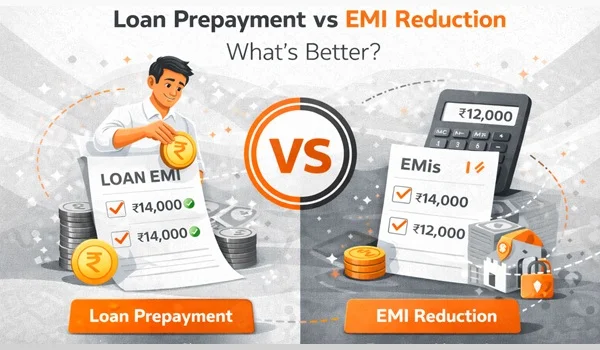
- Reduce the EMI: Continue with the existing loan tenure but pay a lower monthly EMI.
- Reduce the loan tenure: Continue paying the same EMI but close the loan earlier.
Both options reduce your outstanding loan balance, but their impact on total interest payments is different.
What Is EMI Reduction After Personal Loan Prepayment?
EMI reduction means lowering your monthly instalment after making a partial prepayment.
When you pay an additional amount towards your principal, your outstanding loan balance decreases. The lender recalculates your EMI based on the reduced principal while keeping the remaining loan tenure unchanged.
This option is useful for borrowers who want to reduce their monthly financial burden.
Example:
Suppose your outstanding personal loan balance is ₹3 lakh, and you make a partial prepayment of ₹50,000.
Your revised outstanding principal becomes ₹2.5 lakh.
The lender recalculates your monthly EMI based on the new principal, interest rate, and remaining tenure.
As a result, your monthly EMI decreases, making it easier to manage household expenses and other financial commitments.
Benefits of EMI Reduction
- Lower monthly financial burden: You pay a smaller EMI every month.
- Better cash flow: More money remains available for household expenses and other needs.
- Improved financial flexibility: You can use the additional monthly savings for investments or emergency funds.
- Reduced risk of missed EMIs: A lower EMI can make repayment more manageable if your income is limited.
- Useful during financial difficulties: It can help borrowers manage temporary income pressure.
Disadvantages of EMI Reduction
- Higher total interest compared with tenure reduction: Since the loan continues for a longer period, interest accumulates for more months.
- Longer debt commitment: You remain responsible for loan repayments for the original remaining tenure.
- Lower overall savings: You may save less interest than borrowers who maintain their existing EMI and reduce the loan tenure.
What Is Loan Tenure Reduction After Personal Loan Prepayment?
Loan tenure reduction means keeping your existing EMI unchanged while reducing the number of months required to repay the loan.
After making a partial prepayment, your outstanding principal decreases. Instead of reducing your monthly EMI, the lender adjusts the repayment schedule to close the loan earlier.
This option is generally more beneficial for borrowers who can comfortably afford their existing EMI.
Example:
Suppose your outstanding personal loan is ₹3 lakh, and you make a partial prepayment of ₹50,000.
Your revised outstanding principal becomes ₹2.5 lakh.
Instead of reducing your EMI, you continue paying the same monthly instalment. Since the principal is now lower, the loan gets repaid faster.
Benefits of Loan Tenure Reduction
- Higher interest savings: You pay interest for fewer months.
- Faster loan closure: You become debt-free earlier.
- Reduced total repayment: The overall amount paid towards interest decreases.
- Better long-term financial planning: Once the loan is closed, you can redirect the EMI towards savings or investments.
- Less financial liability: You can improve your debt position before taking another loan.
Disadvantages of Loan Tenure Reduction
- No immediate EMI relief: Your monthly instalment remains unchanged.
- Requires stable income: You must continue paying the same EMI every month.
- Limited monthly flexibility: You may have less money available for other financial requirements.
Personal Loan Prepayment vs EMI Reduction: Key Differences
Both options can reduce your outstanding loan amount, but they serve different financial purposes.
The following table explains the major differences.
| Comparison | EMI Reduction | Tenure Reduction |
| Monthly EMI | Decreases | Remains unchanged |
| Loan tenure | Usually remains unchanged | Decreases |
| Interest savings | Generally lower | Generally higher |
| Loan closure | Takes longer | Happens earlier |
| Monthly cash flow | Improves | Remains similar |
| Financial flexibility | Higher | Lower |
| Best suited for | Borrowers needing EMI relief | Borrowers targeting maximum interest savings |
The main difference is that EMI reduction improves monthly cash flow, whereas tenure reduction generally maximises interest savings.
Which Option Saves More Money: EMI Reduction or Tenure Reduction?
In most cases, tenure reduction saves more interest than EMI reduction when the borrower makes the same partial prepayment and continues paying the original EMI.
The reason is simple.
Interest on a personal loan is generally calculated on the outstanding principal. When you maintain the original EMI after prepayment, a larger amount of your monthly payment goes towards reducing the principal.
This helps close the loan faster and reduces the number of months for which interest is charged.
On the other hand, when you reduce your EMI, the monthly repayment amount becomes smaller. However, the loan continues for a longer period, which generally results in higher total interest compared with tenure reduction.
Why Does Tenure Reduction Save More Interest?
Consider the following points:
- Your outstanding principal decreases after partial prepayment.
- Your existing EMI remains unchanged.
- A larger portion of each subsequent EMI goes towards principal repayment.
- Your loan gets closed earlier.
- You pay interest for fewer months.
However, the actual savings depend on the outstanding principal, interest rate, remaining tenure, prepayment amount, and lender’s repayment calculation.
Example: EMI Reduction vs Tenure Reduction
Let’s understand both options through a practical example.
Suppose you have the following personal loan:
| Loan Details | Amount |
| Original loan amount | ₹5,00,000 |
| Annual interest rate | 14% |
| Original loan tenure | 60 months |
| Approximate original EMI | ₹11,634 |
| Outstanding principal after some repayments | ₹3,00,000 |
| Partial prepayment | ₹50,000 |
| Revised outstanding principal | ₹2,50,000 |
For illustration, assume the borrower has 30 months remaining and the lender allows both EMI and tenure recalculation without additional charges.
Option A: Choose EMI Reduction
After making a prepayment of ₹50,000, the outstanding principal becomes ₹2,50,000.
The lender recalculates the EMI while keeping the remaining tenure at 30 months.
- Revised outstanding principal: ₹2,50,000
- Remaining tenure: 30 months
- Approximate revised EMI: ₹9,948
- Approximate total future interest: ₹48,440
This option reduces the monthly EMI by approximately ₹1,686.
Option B: Choose Tenure Reduction
Instead of reducing the EMI, you continue paying the original EMI of approximately ₹11,634.
- Revised outstanding principal: ₹2,50,000
- Monthly EMI: Approximately ₹11,634
- Remaining tenure: Approximately 25 months
- Approximate total future interest: ₹40,850
The loan closes approximately 5 months earlier than the EMI reduction option.
Illustrative calculations use a monthly reducing balance method and rounded figures. Actual lender schedules may differ.
Comparison of Both Options
| Particulars | EMI Reduction | Tenure Reduction |
| Outstanding principal | ₹2,50,000 | ₹2,50,000 |
| Monthly EMI | ₹9,948 | ₹11,634 |
| Remaining tenure | 30 months | Approx. 25 months |
| Future interest | ₹48,440 | ₹40,850 |
| Loan closure | Later | Earlier |
Better for interest savings
Tenure reduction saves approximately ₹7,590 in future interest in this illustration.
EMI reduction, however, provides immediate monthly relief.
When Should You Choose EMI Reduction?
EMI reduction is not always a bad financial decision. It can be the right option when managing monthly expenses is more important than maximising interest savings.
Consider EMI reduction in the following situations.
Your Monthly Income Is Limited
If your monthly income is limited or your household expenses have increased, a lower EMI can make repayment easier.
You can reduce the risk of missing loan payments and maintain better control over your monthly budget.
You Have Other Financial Responsibilities
If you are paying for children’s education, rent, medical expenses, or other household requirements, reducing your EMI may provide additional financial flexibility.
Your Income Is Uncertain
Self-employed individuals, freelancers, and people working in commission-based jobs may have irregular monthly income.
A lower EMI can help them manage repayment during months when earnings are low.
You Want to Build an Emergency Fund
If you do not have sufficient emergency savings, reducing your EMI may help you set aside money every month.
An emergency fund can protect you from taking another loan during unexpected financial situations.
When Should You Choose Tenure Reduction?
Tenure reduction is generally a better option when your monthly income is stable and you can comfortably afford your existing EMI.
Consider this option in the following situations.
You Want to Save Maximum Interest
If your primary goal is to reduce the total interest paid on your personal loan, tenure reduction is generally more beneficial.
It allows you to repay the principal faster and close the loan earlier.
You Have a Stable Monthly Income
Salaried individuals and borrowers with predictable income may find it easier to continue paying their existing EMI.
If your monthly budget has sufficient room, maintaining the original EMI can help you become debt-free faster.
You Want to Improve Your Debt Position
Closing a personal loan earlier can reduce your outstanding liabilities.
This may help you manage future financial commitments more comfortably.
You Are Planning a Major Financial Goal
If you want to save for a house, education, business, or retirement, becoming debt-free earlier can free up money for future financial goals.
Is It Better to Make a Partial Prepayment or Continue Paying EMIs?
Apart from choosing between EMI reduction and tenure reduction, borrowers often face another question: should they make a partial prepayment or continue paying regular EMIs?
The answer depends on the loan’s interest rate and your available savings.
If your personal loan carries a high interest rate, partial prepayment can be financially beneficial because it reduces the principal on which future interest is calculated.
However, you should not use all your savings to repay the loan.
Before making a prepayment, consider the following:
- Maintain an emergency fund for at least 3 to 6 months of essential expenses, depending on your financial situation.
- Keep enough money for upcoming medical, education, and household requirements.
- Compare the loan interest rate with the potential after-tax return on your savings or investments.
- Check whether the lender charges a prepayment or foreclosure fee.
- Avoid taking another expensive loan just to prepay your existing personal loan.
A partial prepayment is useful only when it improves your overall financial position without creating a shortage of emergency funds.
Personal Loan Prepayment Charges and Rules in India
Before making a partial prepayment or closing a personal loan, borrowers should check their lender’s terms and conditions.
Banks and non-banking financial companies (NBFCs) may have different prepayment rules depending on the loan agreement, loan type, and applicable regulations.
Common conditions include:
Part-Payment Charges
Some lenders may charge a fee when borrowers repay a portion of the outstanding principal before the scheduled repayment date.
The charge may be calculated as a percentage of the prepaid amount.
Foreclosure Charges
Foreclosure means repaying the entire outstanding loan before the end of its tenure.
Some lenders may impose foreclosure charges depending on their policy and applicable regulatory requirements.
Minimum Prepayment Amount
A lender may specify a minimum amount that borrowers must pay towards partial prepayment.
For example, the lender may require a minimum prepayment of ₹10,000 or a certain percentage of the outstanding principal.
Lock-in Period
Some loan agreements may include a minimum repayment period before borrowers can make partial prepayments or close the loan.
RBI Rules and Lender Policies
The Reserve Bank of India (RBI) has issued directions concerning prepayment charges on loans.
Under the RBI’s 2025 Directions on Pre-payment Charges on Loans, regulated lenders cannot levy prepayment charges on floating-rate loans to individuals for non-business purposes in the covered cases. These directions apply to loans sanctioned or renewed on or after 1 January 2026.
However, the rules differ for fixed-rate loans and other categories. Therefore, borrowers should check the applicable RBI requirements and their loan agreement before making a payment.
How to Calculate Personal Loan Prepayment Savings
You can estimate your interest savings by comparing the remaining repayment amount under the existing loan schedule with the repayment amount after prepayment.
The basic formula is:
Interest Savings = Interest Payable Without Prepayment − Interest Payable After Prepayment
For a reducing-balance personal loan, EMI is calculated using the following formula:
EMI = [P × R × (1 + R)^N] / [(1 + R)^N − 1]
Where:
- P: Outstanding loan principal.
- R: Monthly interest rate (annual interest rate divided by 12 × 100).
- N: Remaining loan tenure in months.
After making a partial prepayment, you can calculate the revised EMI or revised tenure using the reduced principal.
For accurate results, ask your lender for both repayment schedules:
- Revised EMI schedule after partial prepayment.
- Revised tenure schedule after partial prepayment.
Compare the total future interest under both options to understand which saves more money.
Common Mistakes to Avoid While Prepaying a Personal Loan
Many borrowers make prepayment decisions without checking the financial impact. Avoid these common mistakes.
Ignoring Prepayment Charges
Do not assume that every lender allows free prepayment. Check the charges before making a payment.
Using All Your Savings
Repaying a loan is important, but keeping emergency funds is equally necessary.
Avoid using your entire savings for prepayment if it leaves you financially vulnerable.
Choosing EMI Reduction Without Comparing Interest
A lower EMI may look attractive, but it can result in higher total interest than tenure reduction.
Always compare both repayment schedules.
Not Checking the Outstanding Principal
Before making a payment, obtain the latest loan statement and confirm the outstanding principal.
Not Taking Written Confirmation
After making a prepayment or closing a loan, obtain confirmation from the lender.
If you fully repay the loan, collect the loan closure statement and No Dues Certificate (NDC), wherever applicable.
Tips to Save More Money on a Personal Loan
You can reduce your personal loan interest burden by following a few practical strategies.
- Make prepayments whenever possible: Use surplus funds, bonuses, or additional income to reduce the outstanding principal.
- Prefer tenure reduction: If your income allows, maintain the existing EMI after partial prepayment.
- Compare interest rates: Check whether another lender offers a lower rate through a suitable balance transfer.
- Avoid unnecessary borrowing: Borrow only the amount required for your financial needs.
- Pay EMIs on time: Timely repayment helps avoid late payment charges and protects your credit history.
- Review your loan statement: Check principal repayment, interest charges, and outstanding balances regularly.
- Check foreclosure terms: If you can repay the entire loan, compare the foreclosure cost with the remaining interest.
Frequently Asked Questions (FAQs)
Is EMI reduction better than tenure reduction?
EMI reduction is better when you want to lower your monthly financial burden. However, tenure reduction is generally better when your goal is to save maximum interest and close the loan faster.
Does personal loan prepayment reduce interest?
Yes. Partial prepayment reduces the outstanding principal. Since interest is generally calculated on the outstanding balance, you can save future interest by making an early payment.
Can I reduce my personal loan EMI after partial prepayment?
Yes, many lenders allow borrowers to reduce their EMI after partial prepayment. However, the option depends on the lender’s policies and loan agreement.
Can I reduce my personal loan tenure instead of EMI?
Yes. Some lenders allow borrowers to maintain the existing EMI and reduce the remaining loan tenure after partial prepayment.
Is there any penalty for personal loan prepayment in India?
Prepayment charges depend on the loan type, lender, loan agreement, and applicable RBI regulations. Certain floating-rate individual loans are protected from prepayment charges under the RBI’s applicable directions.
How much personal loan should I prepay?
There is no fixed amount suitable for every borrower. Consider your outstanding principal, interest rate, remaining tenure, emergency savings, and prepayment charges before deciding.
Does personal loan prepayment improve CIBIL score?
Prepayment does not guarantee an immediate increase in your CIBIL score. However, timely repayment and reducing outstanding debt can support a healthy credit profile. Make sure the lender updates the loan status correctly after closure.
Can I close my personal loan before the tenure ends?
Yes. You can generally close a personal loan before its scheduled maturity, subject to the lender’s foreclosure conditions and applicable regulations.
Conclusion
Choosing between personal loan prepayment with EMI reduction and tenure reduction depends on your financial priorities.
Tenure reduction is generally the better option for borrowers who want to save more interest and become debt-free earlier. By maintaining the existing EMI after making a partial prepayment, you can repay the outstanding principal faster.
On the other hand, EMI reduction is suitable for borrowers who want to lower their monthly financial commitments and improve cash flow.
Before making a decision, compare the revised repayment schedules, check prepayment charges, and maintain sufficient emergency savings.
The best strategy is not simply to repay your loan as quickly as possible. It is to reduce your interest burden while keeping your overall financial position stable.